

Right Now

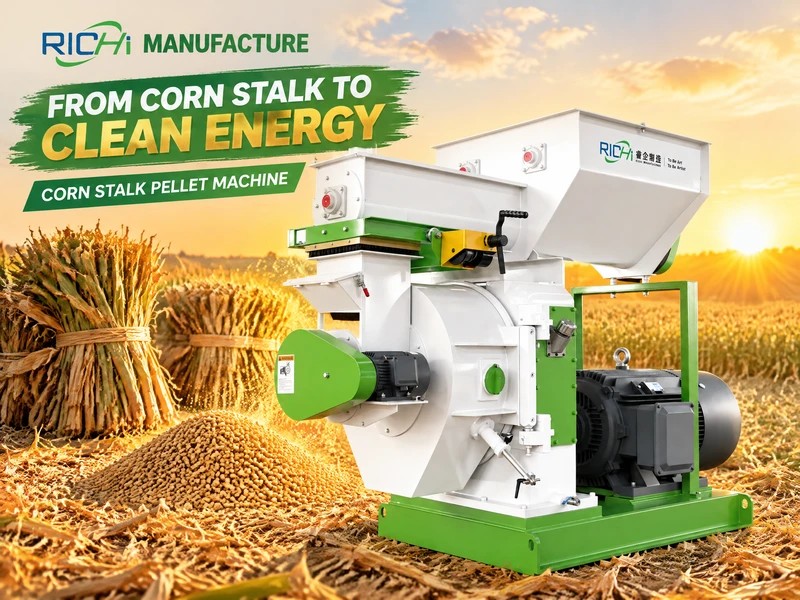
Managing Seasonal Corn Stalk Pellet Production
Agricultural residue businesses face a challenge that many other manufacturing industries do not: raw material availability can change dramatically throughout the year. This seasonal factor should be considered when evaluating corn stalk pellet machine price.
A machine may be capable of producing pellets continuously, but corn stalk may only be collected in large quantities during particular harvesting periods. The relationship between raw material supply and equipment utilization can therefore have a major effect on project economics.
Harvest Season Changes the Production Strategy
Corn stalk is often generated in large volumes during harvesting. If the material is not collected and stored efficiently, a significant portion of the available biomass may become difficult to use later.
This means that a pellet producer may need to think about raw material logistics before deciding on equipment capacity. A larger machine can process more material during peak periods, but it also requires sufficient feedstock and supporting infrastructure.
The objective is to create a production schedule that makes reasonable use of the equipment throughout the year.
Storage Can Change the Economics
Storage is not simply a place to keep raw material. It affects moisture, handling, transportation, and production continuity.
If corn stalk is collected seasonally but pellet production is planned throughout the year, storage capacity becomes part of the overall project. The operator must consider how much material can be safely stored and how it will be moved into the processing system.
A well-organized storage strategy can allow the pellet machine to operate beyond the harvesting period, improving equipment utilization.
Equipment Utilization Matters
Suppose two facilities purchase similar pellet machines. One has a stable year-round supply of raw material, while the other can operate mainly during a short harvesting season.
The second facility may produce the same amount of pellets during its operating period but have lower annual machine utilization. As a result, its equipment cost is spread across fewer production hours.
This illustrates why biomass straw pellet machine selection should be connected to annual feedstock availability rather than only the maximum hourly capacity.
Combining Different Agricultural Residues
Seasonal variation can sometimes be addressed by processing more than one type of biomass. Depending on local availability and pellet requirements, agricultural residues such as wheat straw, rice husks, grass, or other fibrous materials may be considered.
Using multiple feedstocks can potentially extend the operating season, but each material must still be evaluated for moisture, particle size, density, and pelletizing behavior.
The goal is not simply to add more materials but to create a stable and manageable raw material strategy.
Why Small Operations Face Different Challenges
For smaller farms or agricultural cooperatives, seasonal supply can make a compact production setup more practical. Instead of trying to maximize industrial output, the operator may focus on processing locally available material when it is abundant.
Such operations may use pellets for farm heating, bedding, or other local applications. Because the production scale is smaller, equipment utilization and storage can be planned around local needs.
An anonymous local operator may even prefer flexible production rather than maximum capacity, particularly when the primary objective is to reduce agricultural waste.
Turning Seasonal Waste Into a Stable Product
Pellets can help make agricultural residues easier to store, transport, and handle. Loose stalks occupy substantial space and can be difficult to move economically over long distances.
Densification changes the physical form of the material, creating a more concentrated product that can be stored and transported more efficiently.
This transformation is one reason agricultural pellet production can remain attractive even when raw material availability is seasonal.
Comparing Agricultural and Wood Biomass
Some operators may consider processing both agricultural residues and forestry materials. However, these materials should not automatically be treated as interchangeable.
A wood pellet machine may be configured for specific wood-processing conditions, while agricultural residues can have different fiber characteristics and preparation requirements.
The right equipment should therefore be selected according to the actual material mix rather than the desired product name alone.
Seasonality ultimately makes pellet equipment planning a logistics problem as much as a mechanical one. Understanding when raw material arrives, how it will be stored, and how long the equipment can realistically operate each year provides a much stronger basis for evaluating investment cost.
More Posts





Report This Post
Please complete the following requested information to flag this post and report abuse, or offensive content. Your report will be reviewed within 24 hours. We will take appropriate action as described in Findit terms of use.
