


Right Now

Beyond the Barrel: Strategic Shifts in the Cooperage Equipment Market Through 2032
The global cooperage equipment market has moved from a niche craftsmanship domain into a structured industrial segment with measurable trajectory. Revenue in this sector reached an estimated 210.5 million USD in 2025, building on a compound annual growth rate of 6.85 percent over the 2020–2025 period. The growth curve does not flatten after the current cycle. Projections indicate expansion to roughly 228.85 million USD in 2026, climbing toward 336.32 million USD by the end of the 2032 forecast window. Behind these headline figures sits a market defined by uneven regional maturity, a clear preference for automated processing lines, and a dominance of food and beverage applications that shapes equipment design priorities. The structural story matters more than any single year’s number, because the next phase will reward operators who align capacity investments with automation readiness, raw material volatility, and regulatory pressure on production traceability.
Market Context and the Three Pressure Points Reshaping the Segment
The market expansion is real, but it is not uniform. Revenue growth masks a landscape where concentration remains moderate, with the top three participants accounting for approximately 38.5 percent of total market activity and the leading five representing 52.7 percent. That distribution suggests room for both specialized challengers and consolidation plays. It also signals that incumbents cannot rely on customer inertia alone; procurement teams are comparing vendors on throughput, integration complexity, and lifecycle support rather than brand recognition alone.
Three pressure points define the current industrial moment for cooperage equipment buyers and suppliers.
- Raw material pricing pressure is reshaping project economics. The cost volatility of primary forestry inputs is already visible in segment pricing dynamics, with French oak stave prices increasing 12 percent year-over-year in 2025 due to supply constraints from European forests. Equipment manufacturers and end users are responding with throughput optimization and maintenance strategies that reduce waste per barrel produced.
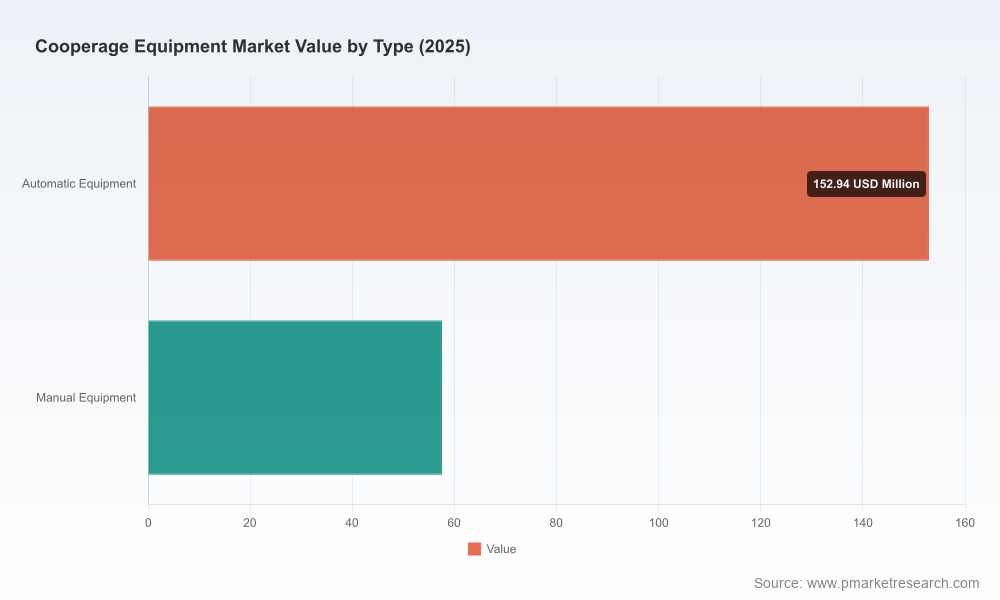
- Automation adoption is crossing from optional upgrade to competitive baseline. Automatic equipment now represents the larger revenue share within the equipment type split, reflecting a structural move toward higher consistency, reduced labor variability, and faster line changeovers. The shift is not merely about purchasing a machine; it is about integrating handling, washing, toasting, and finishing workflows into a coherent production architecture.
- Regulatory and compliance expectations are tightening around production transparency and sanitation. Food and beverage applications dominate the application mix, which means equipment must increasingly support validated cleaning protocols, material handling traceability, and process documentation. This is particularly relevant for producers exporting to markets with stringent food safety and labeling requirements.
For executives evaluating the segment, the takeaway is simple: the market is not merely getting bigger, it is getting more operationally demanding. Providers that can combine durable mechanical performance with integrated cleanliness, reduced material waste, and predictable maintenance schedules will capture a disproportionate share of the next growth cycle.
Core Drivers: Why the Cooperage Equipment Segment Is Reorienting
Technology Upgrade Cycles and Throughput Architecture
The most visible driver is the accelerating upgrade cycle around toasting, steaming, barrel handling, and cleaning systems. Prospero Equipment Corporation’s updated equipment catalog released in October 2025, featuring enhanced barrel toasting and steaming lines, illustrates a broader industry pattern: equipment suppliers are not just refreshing mechanical components, they are expanding machine families that improve thermal consistency and reduce operator dependency. That matters because barrel quality is increasingly tied to reproducible process parameters rather than artisanal judgment alone. When toasting and steaming can be controlled with tighter tolerances, producers gain both consistency across batches and the ability to scale premium product lines without proportionally scaling skilled labor.
The strategic implication is twofold. First, equipment buyers are likely to prioritize vendors whose product roadmaps address thermal control, integrated handling, and modular line expansion. Second, manufacturers face a continuous R&D cadence: incremental improvements in heating uniformity, moisture management, and automation interfaces are becoming table stakes rather than differentiators. Companies that treat equipment design as a process-engineering service, rather than a standalone hardware sale, will have an easier time defending pricing and extending customer lifetimes.
Policy and Regulatory Pressures Becoming Operational Design Inputs
Regulatory expectations are increasingly influencing equipment specifications. Food and beverage production remains the dominant demand source within the application landscape, and that concentration channels compliance requirements directly into machinery design. Sanitation validation, wash coverage consistency, and documentation of cleaning cycles are no longer peripheral concerns; they are procurement criteria. Equipment that supports efficient washdown, reduces dead zones, and simplifies inspection can lower compliance friction across multiple jurisdictions.
This is also a regional story in practice, even if the compliance logic applies globally. European and North American producers, which account for substantial portions of current market activity, tend to operate under frameworks that reward documented process control. Suppliers that embed compliance-friendly design features can reduce the total cost of ownership for buyers who must satisfy auditors, export inspectors, or internal quality systems. In other words, regulatory pressure is becoming a design constraint that can be converted into a commercial advantage when addressed proactively.
Demand-Side Shifts in Premiumization and Production Flexibility
Demand is being reshaped by premiumization, brand differentiation, and the need for flexible batch production. Producers in wine and spirits are not just seeking volume; they are seeking the capability to run varied barrel profiles, maintain quality across smaller runs, and reduce turnaround time between batches. This favors equipment that can handle automated barrel movement, consistent washing, and controlled toasting without sacrificing flexibility. The value is not only in higher output but in the ability to switch configurations without major downtime or revalidation costs.
A second demand-side change is the growing awareness of resource efficiency. When stave prices and forestry supply tighten, waste reduction becomes a financial imperative rather than a sustainability gesture. Equipment that lowers breakage, improves handling safety, and supports faster cleaning cycles directly improves unit economics. For procurement teams, the question is increasingly “what does this machine save per barrel over its service life,” not simply “what is the purchase price.”
Supply-Side Realities: Inputs, Lead Times, and Cost Structures
The supply environment is quietly redefining competitive positions. Forest-sourced inputs are subject to environmental constraints and logistics volatility, which feeds directly into equipment planning. When raw material availability becomes less predictable, producers value equipment that can maintain throughput with tighter material use, faster turnaround, and fewer rejected units. That shifts buyer attention toward total operational reliability and away from one-time capital cost.
At the same time, the supply chain for advanced cooperage equipment itself is becoming more specialized. Suppliers with strong service networks, spare-part availability, and remote support capabilities are better positioned to retain customers during periods of input stress. The cost structure of ownership is increasingly influenced by uptime, service response, and integration quality. In that environment, a lower sticker price can be less attractive than a higher reliability profile with documented maintenance intervals and predictable consumable usage.
Competitive Positioning: Who Is Winning the Next Cycle and Why
The competitive field in cooperage equipment is specialized, geographically dispersed, and increasingly defined by workflow coverage rather than single-machine capability. Three profiles illustrate the range of strategic positioning currently shaping the market.
Prospero Equipment Corporation and the Product-Line Expansion Play
Prospero Equipment Corporation, headquartered in Windsor, California, supplies cooperage equipment including barrel washers, hoop drivers, and stave planers for wine and spirits producers. Its recent product catalog refresh in October 2025, emphasizing enhanced barrel toasting and steaming equipment lines, points to a strategy centered on deepening the thermal-processing portfolio and strengthening the upgrade path for existing users. This type of move is strategically significant because toasting and steaming sit at the center of barrel character formation and process reproducibility. By expanding that product family, the company is positioning itself closer to the highest-value stages of the production process, where consistency and control command stronger customer attention.
Wine Fermentation Equipment Market
The differentiation advantage here is not simply broader selection; it is the coherence of a lines-of-business approach. If a supplier can offer washers, hoop drivers, planers, and toasting equipment that share servicing logic and installation standards, it lowers integration risk for buyers. That coherence can translate into longer relationship cycles and more predictable aftermarket revenue.
PW Consulting Automotive & Machinery Research Center
Winequip and the Integrated Handling and Repair Angle
Winequip, based in Melbourne, Australia, provides cooperage machinery such as barrel repair tools, toasting equipment, and automated barrel handling systems. Its positioning reflects a different strategic emphasis: lifecycle management and handling efficiency. Barrel repair tools and automated handling systems address practical bottlenecks in high-throughput environments, where downtime from damaged barrels or manual movement can quietly erode margins. By including toasting equipment alongside handling systems, the company is also signaling that it understands the production line as a sequence rather than a set of isolated machines.
The strategic value of this approach lies in operational continuity. A buyer concerned with throughput variability, staffing constraints, or barrel damage reduction may prefer a supplier that covers both preparation and movement. That preference becomes stronger in operations where labor availability is tight and where consistency in barrel rotation and handling is linked to quality outcomes.
Vintner Vault and the Distribution-to-Production Bridge
Vintner Vault, located in Paso Robles, California, distributes cooperage equipment including barrel racks, washing systems, and maintenance tools for commercial wineries. Its model highlights the importance of accessibility, application-specific configuration, and support proximity for winery-scale operations. Distribution-focused models can be powerful when paired with knowledgeable configuration services, because many producers need practical matching between equipment capabilities and facility layout, batch size, and hygiene requirements.
The commercial advantage here is customer intimacy at the operational level. Suppliers that can advise on rack placement, washing coverage, and maintenance tool selection reduce the implementation burden for buyers. That, in turn, makes adoption easier and increases the likelihood that the equipment will be used to its intended capacity. In a market where underutilization can erase the benefits of automation, implementation support is a meaningful competitive lever.
How the Landscape Is Evolving
The competitive structure is moving along two tracks simultaneously. On one track, established suppliers are expanding product coverage to reduce fragmentation in the customer’s plant design. On the other, regional specialists and service-led distributors are strengthening local relevance, often by tailoring configurations to winery and spirits production realities. This combination suggests a market that is neither fully consolidated nor purely fragmented. The top five participants hold just over half of market activity, which indicates that scale matters, but not enough to block focused challengers who bring superior integration logic or service responsiveness.
New entrants and adjacent suppliers are most likely to succeed if they address a clear operational gap: automated handling, validated cleaning, thermal consistency, or service accessibility. Pure price competition is less durable in a market where downtime, waste, and compliance risk carry visible costs. The more sustainable battleground is total cost of ownership and installation confidence, supported by credible product roadmaps and regional service capacity.
Outlook for 2026 to 2032: Three Trends That Will Shape Commercial Opportunity
The forward trajectory is not simply a matter of incremental revenue growth. The combination of automation preference, input volatility, and application concentration suggests that the next several years will reward businesses that align product strategy with operational risk reduction. Three developments are especially likely to shape commercial opportunity.
- Automated toasting, steaming, and handling lines will become the default reference architecture for scaling producers. As automatic equipment continues to dominate the equipment type mix, suppliers will be expected to deliver not just standalone machines but integrated sequences that reduce manual variability and support repeatable barrel profiles. This shift creates opportunity for vendors that design equipment with configurable throughput and modular expansion, as well as for service providers that can maintain those lines across different facility sizes.
- Compliance-friendly equipment will gain share in export-oriented and regulated markets. The dominance of food and beverage applications means that cleanability, wash coverage, and process documentation will increasingly influence purchasing decisions. Equipment that simplifies sanitation procedures and reduces validation complexity can win on operational convenience and audit readiness, not merely on mechanical performance.
- Input volatility will push the market toward efficiency-oriented procurement. With forestry-sourced material costs and availability under pressure, buyers will look for equipment that lowers waste, shortens turnaround, and improves handling safety. This will elevate the importance of lifecycle economics and reward suppliers that can quantify per-barrel savings, uptime, and consumable usage over multi-year horizons.
These trends carry risk as well. Overinvestment in automation without disciplined integration planning can leave producers with complex lines that are difficult to balance or maintain. Regional supply disruptions may also make it harder for equipment manufacturers to sustain lead times and spare-part availability, particularly if demand concentrates in a few growth markets. Additionally, if premiumization slows in certain categories, producers may defer capacity expansion, shifting the market’s growth rhythm from steady adoption to episodic project spending. Companies operating in this environment need to track demand signals by application and region, not just by aggregate revenue.
What This Means for Decision Makers
The strategic lesson from the current market picture is that cooperage equipment is becoming a process-integration decision rather than a discrete capital purchase. That has direct consequences for manufacturers, investors, and procurement teams.
For Equipment Manufacturers and Suppliers
Product strategy should prioritize coherence across the production sequence. Rather than competing solely on the specifications of a single machine, suppliers can build advantage by reducing integration friction across washing, toasting, steaming, and handling workflows. That includes shared service standards, compatible control logic where appropriate, and clear upgrade paths. The October 2025 expansion of enhanced barrel toasting and steaming equipment lines by Prospero Equipment Corporation is a useful example of the direction: it widens the addressable part of the process where consistency and control matter most. Manufacturers should also treat service and spare-part availability as strategic assets, because uptime guarantees and response reliability are increasingly part of competitive positioning.
Construction Equipment Market
For Investors and Strategic Allocators
The market’s mid-30s million USD scale by early next year and projected advance toward the mid-300 million USD range by 2032 suggests a segment with meaningful expansion potential, but the value is not evenly distributed across business models. Investments are likely to perform better where they support automation integration, compliance-friendly design, or service-led revenue streams rather than commodity hardware sales alone. Concentration data, with the top three participants at roughly 38.5 percent and the top five at 52.7 percent, indicates that incumbents have scale advantages, yet there remains room for specialized players that solve an operational bottleneck better than larger generalist suppliers. Investors should therefore monitor product roadmap credibility, regional service coverage, and the ability to translate equipment performance into measurable waste and labor reductions.
For Procurement Teams and Production Buyers
Buying decisions should be evaluated on total lifecycle economics and implementation risk. Automatic equipment is no longer a luxury add-on; it is becoming the baseline for producers seeking consistent throughput and reduced operational variability. That means comparison criteria should include cleaning validation support, handling reliability, maintenance intervals, and integration with existing facility layout. The 12 percent year-over-year increase in French oak stave prices in 2025 is a reminder that input stress can invert the usual cost calculus, making waste reduction and faster turnaround more valuable than a marginal difference in purchase price. Procurement teams should also request evidence of per-barrel efficiency, cleaning cycle performance, and service response commitments, because those factors determine whether an equipment investment pays back under real operating conditions.
Turning Market Signals into Investment-Grade Decisions
The cooperage equipment market is entering a phase where growth and complexity reinforce each other. Aggregate expansion to an estimated 336.32 million USD by 2032 provides a strong backdrop, but the real opportunity lies in understanding where automation, compliance, and input constraints are changing the economics of production. The winners in this cycle will be the companies that treat equipment as part of an operational system, not as an isolated asset, and that can defend their position through integration quality, service reliability, and measurable efficiency gains.
For decision makers building strategy around capacity expansion, vendor selection, or market entry, the most valuable next step is to map these broad trends against segment-specific demand patterns, regional dynamics, and company-level capabilities. Detailed breakdowns of equipment type adoption, regional growth intensity, application-led procurement behavior, and competitive benchmarking provide the precision needed to turn the market narrative into executable plans. The complete PW Consulting research report on the cooperage equipment market offers that deeper view, with granular segmentation, revenue trajectories, and tailored recommendations designed to support investment and procurement decisions across the 2026–2032 horizon.
For detailed analysis of this topic, please visit the official page: Cooperage Equipment Market
Lacy Lee
Senior Marketing Manager
sales@pmarketresearch.com
00852-95632430
PW Consulting: www.pmarketresearch.com
More Posts


Report This Post
Please complete the following requested information to flag this post and report abuse, or offensive content. Your report will be reviewed within 24 hours. We will take appropriate action as described in Findit terms of use.
