


Right Now

Navigating the Strategic Evolution of the Global Molten Salt Pumps Market
The molten salt pumps market is entering a decisive growth phase, driven by the convergence of renewable energy expansion, advanced nuclear development, and industrial processes demanding high-temperature fluid handling. Valued at approximately $554.2 million in 2020, the market climbed to $834.08 million by 2025, and is projected to reach $1.53 billion by 2032, reflecting a compound annual growth rate of 9.1 percent. This trajectory signals more than incremental expansion; it represents a structural shift in how high-temperature thermal systems are designed, deployed, and sustained. For executives, investors, and engineers operating across energy and industrial sectors, the market’s direction offers clear signals about where capital, capability, and supply chain partnerships will be concentrated over the next decade. The opportunity lies not in reacting to volume growth, but in anticipating the technical, regulatory, and competitive forces that will separate mature players from market leaders.
Market Landscape and Core Challenges
The market’s expansion is anchored by steady demand from concentrated solar power installations and thermal energy storage deployments, complemented by emerging applications in advanced reactor development and high-temperature industrial processing. While the overall revenue trajectory points toward consistent double-digit expansion over the forecast period, the sector is navigating a set of operational and strategic friction points that will shape profitability and market share distribution. Two structural challenges dominate the current landscape: the technical burden of extreme operating conditions and the evolving procurement expectations tied to long-lifecycle infrastructure projects.
Managing High-Temperature and Corrosive Service Demands
Pumps designed for molten salt service must operate reliably in environments where temperatures routinely exceed 600°C and salt chemistry introduces aggressive corrosion and wear. This requirement pushes manufacturers beyond conventional metallurgy into specialized alloys, ceramic-metallic composites, and advanced thermal barrier coatings. The performance gap between standard high-temperature pumping and true molten salt service is substantial, and the cost of failure in these systems is equally significant. A compromised seal, premature bearing degradation, or inconsistent flow stability can disrupt entire thermal loops, undermining plant availability and financial returns. As a result, engineering capability has become a primary competitive barrier, and suppliers are increasingly selected as much for material science expertise as for hydraulic design.
Project Economics and Long-Cycle Procurement
The market is also influenced by the procurement rhythms of concentrated solar and nuclear-adjacent programs, where equipment selection is tied to decades-long operational expectations. Buyers are increasingly focused on integrated performance rather than individual component pricing. This shifts competition toward total cost of ownership, maintenance accessibility, thermal distortion mitigation, and validated field reliability. Suppliers that can demonstrate predictable behavior under thermal cycling and salt exposure are gaining an advantage, while those relying on generalized pump configurations face growing pressure to justify their value in highly specialized applications.
Regional Growth Patterns and Supply Chain Realities
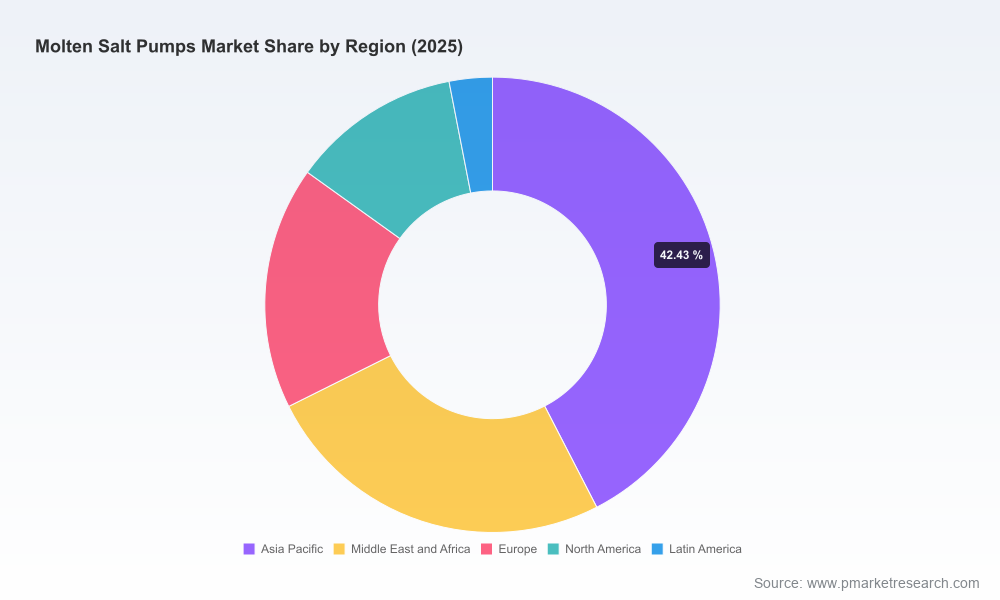
Demand is distributed across multiple regions, with Asia Pacific, the Middle East and Africa, Europe, North America, and Latin America each contributing differently to overall market volume. Rather than a single dominant geography, the market reflects a mix of policy-driven renewable programs, industrial modernization efforts, and pilot-scale advanced reactor activity. This geographic diversification introduces both opportunity and complexity. Manufacturers must navigate differing certification expectations, local content preferences, logistics for oversized or highly specialized equipment, and the need for regional technical support. The firms best positioned to scale are those that can combine global engineering consistency with localized project execution.
Key Drivers Shaping Market Direction
The market’s growth is not accidental; it is being pulled forward by a small number of reinforcing forces. These drivers intersect across technology, policy, demand behavior, and supply chain economics, and they collectively define where the most durable commercial opportunities will emerge.
Engineering Innovation in High-Temperature Materials and Thermal Management
Material and design innovation remains the central enabler of market expansion. Advanced wetted components increasingly rely on nickel-based alloys and high-velocity oxygen fuel coatings tailored for chloride and nitrate salt environments. Pump architectures are also evolving to address thermal distortion, with features such as advanced thermal mapping, precision balancing for vertical configurations, and bearing systems built for sustained high-temperature operation. These advances are not purely incremental. They allow equipment to move from niche experimental use into mainstream deployment by improving reliability and reducing operational risk. The practical impact for buyers is clear: as material performance improves, molten salt systems can be designed with tighter margins, longer maintenance intervals, and greater confidence in continuous operation.
Policy Support and the Push Toward Safer, Longer-Lasting Thermal Systems
Policy and funding priorities are reinforcing the case for high-performance molten salt pumping. In the United States, Department of Energy Gen3 concentrated solar power initiatives have emphasized improving the reliability and longevity of high-temperature chloride salt pumps through better materials and design approaches. This focus aligns with broader energy resilience goals, where thermal storage and dispatchable solar generation are increasingly valued for grid stability. At the same time, regulatory scrutiny around safety, interoperability, and lifecycle performance is raising the bar for equipment qualification. Suppliers that proactively align with emerging qualification expectations and can document performance under relevant conditions are more likely to secure approvals and project inclusion.
Demand Expansion Across Concentrated Solar Power, Thermal Storage, and Advanced Reactors
On the demand side, the strongest pull continues to come from concentrated solar power with integrated thermal storage, where molten salt circulation and transfer pumps are essential to plant function. This application area remains the largest demand pool because it directly links renewable generation to dispatchable output. Alongside this, thermal energy storage deployments are broadening the use case for high-temperature pumps beyond solar-specific designs, and emerging molten salt reactor development is creating a new class of requirements that stress precision, corrosion resistance, and long-duration reliability. Industrial chemical processing and high-temperature manufacturing also contribute, though at a smaller scale. The key strategic insight is that demand is diversifying by application while consolidating around a common technical core: robust, high-temperature fluid handling.
Supply Chain Maturation and the Growing Importance of Lifecycle Support
Supply chain dynamics are reshaping how competitive advantage is built. As more projects move from feasibility to construction and commissioning, the market is placing greater weight on manufacturing consistency, localized fabrication, and after-sales service capability. The emphasis on 30-year operational horizons in several CSP applications means that suppliers are being evaluated not only on hardware delivery, but also on spares availability, field service responsiveness, and the ability to support thermal mapping or retrofit work over time. This creates a natural pull toward companies with broader service ecosystems and documented project experience. Conversely, it raises entry barriers for firms that can manufacture a pump but cannot guarantee long-term operational support.
Competitive Landscape and Leading Strategies
The market is moderately concentrated, with the top three participants capturing roughly 42.5 percent of revenue and the top five reaching about 58.8 percent. This structure reflects a blend of established international pump manufacturers, specialized high-temperature equipment providers, and regional producers with growing project exposure. Rather than a uniform landscape, the market is shaped by distinct strategic profiles and differing approaches to technology, geography, and application focus.
Differentiated Positioning Among Leading Manufacturers
Sulzer has built visibility around vertical mixed-flow molten salt circulation pumps for concentrated solar applications, with capacity ranges suited to parabolic trough and central tower systems. Its recent activity highlights a deliberate push into energy storage infrastructure, including contracts tied to molten salt storage facilities and large CSP tower projects in China. This positions Sulzer as a supplier that can connect established CSP expertise with broader storage-driven demand.
Flowserve has emphasized long-cycle durability in its vertical turbine pump designs for molten salt service, including thermal mapping solutions intended to reduce heat distortion. The company’s positioning reflects a durability-first approach that resonates with buyers evaluating multi-decade operational performance.
WEM Pumps marks a different entry point, with long-standing experience in molten salt transfer for steel production, battery-related systems, and experimental reactor work. This broader application base gives the company a historically grounded perspective on high-temperature transfer conditions outside mainstream CSP.
Hayward Tyler stands out for custom high-temperature pump engineering targeting molten salt, liquid metal, and liquid sodium systems at temperatures above 750°C, with a particular footprint in advanced nuclear and CSP-related programs. Its emphasis on bespoke solutions appeals to projects with unusual operating conditions or specialized material requirements.
Rheinhütte Pumpen brings corrosion-proof, wear-resistant design experience dating back to nitrate salt applications, and continues to serve CSP and industrial users with submersible chemical pump expertise. Its long material experience is a differentiator in environments where chemical compatibility and component durability are decisive.
Auro Pumps offers a vertically integrated angle, manufacturing molten salt pumps and complete molten salt systems and loops for high-temperature industrial and solar use. This systems-oriented capability can reduce integration complexity for buyers seeking end-to-end responsibility.
Worldwide High Pressure Melt Pump Market
Regional players such as Zigong Pump & Valve and Jinan Warwick Pump focus on vertical high-temperature submerged and axial flow designs for solar thermal power applications, contributing to cost-competitive supply and growing project exposure in solar-heavy markets. Nagle Pumps remains associated with vertical cantilever configurations that have established use in molten salt pumping, reinforcing the importance of proven mechanical architectures.
Market Evolution: Consolidation, Specialization, and New Entrants
The competitive picture is evolving along two parallel paths. On one side, larger multinational suppliers are deepening their presence in high-temperature energy storage and CSP through project awards, localized manufacturing, and service expansion. On the other, specialized and regional manufacturers are competing on customization, material expertise, application breadth, and delivery economics. This creates a pattern of partial consolidation at the top, alongside persistent fragmentation in niche applications and regional supply chains.
New entry is possible, but it is highly conditioned. The market rewards documented high-temperature experience, material compatibility knowledge, and the ability to support long-lifecycle projects. As a result, entrants typically succeed by solving a narrow technical problem exceptionally well or by offering an integrated system approach, rather than by competing solely on general pump pricing. Recent project activity reinforces this pattern. For example, a two-year continuous operation milestone for a molten salt pump and test loop has validated critical component behavior in reactor-relevant conditions, while contract awards in CSP and storage have underlined demand for robust high-temperature circulation equipment. These developments suggest that feasibility and validation work is increasingly translating into commercial deployment, which in turn tends to favor suppliers with proven field track records.
Forward Outlook: Trends Defining the Next Three to Five Years
Looking ahead, the molten salt pumps market is likely to be shaped by a handful of trends that connect technical progress with commercial opportunity. These are not speculative shifts; they follow directly from current project activity, material development, and the growing scale of thermal storage and advanced nuclear work.
Magnetic Pumps Market
Trend One: Broader Application Mix Beyond Conventional CSP
While concentrated solar power remains central, the application base is broadening. Thermal energy storage deployments are creating additional demand for reliable high-temperature circulation and transfer equipment, and molten salt reactor development is introducing new specifications that reward precision and corrosion-resistant design. This diversification matters because it reduces dependence on any single program type and opens multiple growth pathways. For suppliers, the strategic implication is to design portfolios that can serve CSP, storage, reactor, and selected industrial applications without compromising specialization. The commercial opportunity lies in reusable core architectures with application-specific adaptations, which can shorten engineering cycles and improve margin consistency.
Trend Two: Material and Coating Advances as a Competitive Moat
Material science will increasingly determine market leadership. As operating temperatures and chloride salt use expand, the performance of wetted components, bearings, and coatings becomes a decisive factor in reliability and acceptance. Solutions incorporating high-performance alloys and advanced ceramic-metallic or HVOF-based coatings are likely to move from specialized use toward broader deployment in demanding environments. Suppliers that can standardize these material choices while maintaining design flexibility will gain an advantage in qualification speed, maintenance predictability, and customer confidence. The risk is that material complexity raises cost and supply dependencies, so companies must balance performance gains with manufacturability and sourcing resilience.
Trend Three: Lifecycle Value Replacing Unit Price as the Primary Buying Criterion
As installations become more capital-intensive and operational expectations lengthen, procurement decisions are increasingly driven by lifecycle performance rather than first cost. This favors suppliers that can offer validated reliability, thermal distortion mitigation, maintenance planning clarity, and service responsiveness. It also increases the importance of documentation, testing evidence, and field references. Projects that can prove long-term behavior under thermal cycling and corrosive conditions will have an easier path through approval and procurement processes. For commercial teams, the opportunity is to shift the conversation from equipment price to availability, uptime, and total cost of ownership, while building the evidence base needed to win in demanding tenders.
Risk Considerations and Uncertainties
Despite the favorable trajectory, several uncertainties persist. Project delays, financing constraints, and shifts in energy policy can slow near-term deployments, particularly in large-scale CSP and emerging reactor programs. Material supply volatility and the complexity of qualifying advanced alloys or coatings can raise lead times and costs. In addition, as more participants enter specialized high-temperature segments, competition may intensify in select regions or applications, pressuring margins for suppliers that lack differentiation. Managing these risks will require disciplined application focus, strong qualification data, and flexible sourcing strategies.
Strategic Actions for Decision Makers
The market’s direction suggests that the most valuable moves are those that align technical capability with application strategy and long-cycle support. Depending on a company’s role in the value chain, the priority actions differ, but the common thread is preparation for a market where performance validation, materials expertise, and lifecycle service increasingly determine commercial success.
PW Consulting
For Manufacturers and Equipment Suppliers
Focus on a credible high-temperature core rather than broad but shallow product coverage. Deep competence in material compatibility, thermal distortion management, and bearing/seal performance for nitrate or chloride salt service is more valuable than a wide catalog that only partially addresses molten salt conditions. Where possible, develop platform-based designs that can be adapted across CSP, storage, and select industrial applications, reducing engineering duplication while preserving specialization. Equally important is building the service and documentation backbone that supports multi-decade operation, including spares strategy, field service capability, and evidence packages that simplify qualification and procurement approval.
For Investors Evaluating Exposure
Prioritize companies with demonstrated high-temperature pump experience, enforceable material and coating expertise, and a credible path to serving multiple demand pools without diluting engineering focus. The strongest risk-adjusted opportunities are likely to be found where revenue is tied to validated applications and where the supplier’s differentiation is difficult to replicate quickly. Be cautious of business models dependent on single-project volatility or on generic pump positioning without clear molten salt specialization. In due diligence, examine field references, qualification documentation, service capacity, and exposure to emerging reactor and storage demand as indicators of durability.
For Procurement and Engineering Leaders
Evaluate suppliers against total lifecycle criteria, including thermal performance under expected operating conditions, corrosion and wear resistance, maintenance accessibility, and evidence of long-duration reliability. Where projects involve chloride salt service or temperatures above 600°C, insist on detailed material and coating specifications and validate them against the intended chemical and thermal environment. If integration risk is a concern, consider suppliers capable of delivering pumps within broader molten salt system setups, as this can reduce interface complexity and streamline commissioning. Finally, build procurement timelines that account for qualification evidence, specialized fabrication, and the potential need for localized support or after-sales service.
Closing Perspective
The molten salt pumps market is moving from a specialized niche into a more central role within high-temperature energy and industrial systems. Its growth is supported by expanding concentrated solar power and thermal storage activity, emerging reactor development, and ongoing advances in materials and thermal management. Yet the market’s most telling feature is not its size alone, but the way competitive advantage is being rebuilt around reliability, material science, and long-cycle support. As project activity increases and application diversity widens, the organizations that act early on these shifts will be better positioned to capture demand, manage risk, and shape the next phase of market evolution. For decision makers seeking a more detailed view of segmentation, regional dynamics, competitive benchmarks, and customized strategic options, the full PW Consulting research report offers a deeper breakdown of the data and implications behind this trajectory.
For detailed analysis of this topic, please visit the official page: Worldwide Molten Salt Pumps Market
Lacy Lee
Senior Marketing Manager
sales@pmarketresearch.com
00852-95632430
PW Consulting: www.pmarketresearch.com
More Posts


Report This Post
Please complete the following requested information to flag this post and report abuse, or offensive content. Your report will be reviewed within 24 hours. We will take appropriate action as described in Findit terms of use.
