


Right Now

Strategic Horizons: Mapping the Worldwide Sapphire Powder Market, 2026-2032
The global market for sapphire powder—a specialized raw material critical to the production of synthetic sapphire crystals and high-performance ceramics—has entered a phase of resilient, structural growth. Valued at approximately USD 545 million in 2025, the market is projected to reach nearly USD 890 million by 2032, expanding at a compound annual growth rate of 7.25 percent. This trajectory, built on a five-year historical foundation of steady expansion, reflects a sector transitioning from steady-trim engineering to a materials enabler of advanced electronics, optics, and precision manufacturing. The current landscape rewards participants who can navigate purity requirements, cost structures, and evolving end-use specifications with strategic discipline.
PW Consulting
Market Snapshot: Size, Structure, and the Current Crossroads
The market has demonstrated consistent top-line expansion, moving from USD 384 million in 2020 through a series of annual gains that culminated in the current 2025 valuation of USD 545 million. The forecast window through 2032 points to continued upward momentum, with the market crossing the USD 700 million threshold around 2029 and approaching USD 890 million by the end of the projection period. This growth is not merely cyclical; it is anchored in the material's irreplaceable role as feedstock for synthetic sapphire crystal growth, high-purity ceramics, and precision abrasives. The market's trajectory signals a maturing industry where value differentiation increasingly depends on purity grades, production process innovation, and the ability to align material properties with demanding downstream specifications.
Industry structure reveals meaningful concentration, with the top three participants collectively accounting for 41.25 percent of total revenue and the top five holding 56.8 percent. Such concentration suggests that scale, production consistency, and established qualification cycles in critical applications—particularly electronics and optoelectronics—create natural barriers to entry. At the same time, the remaining share points to a diverse field of regional suppliers, niche specialists, and distribution networks that serve research, prototyping, and specialized industrial needs. This blend of concentrated incumbency and fragmented service layers creates a competitive environment where both scale players and agile specialists can find viable strategic positions.
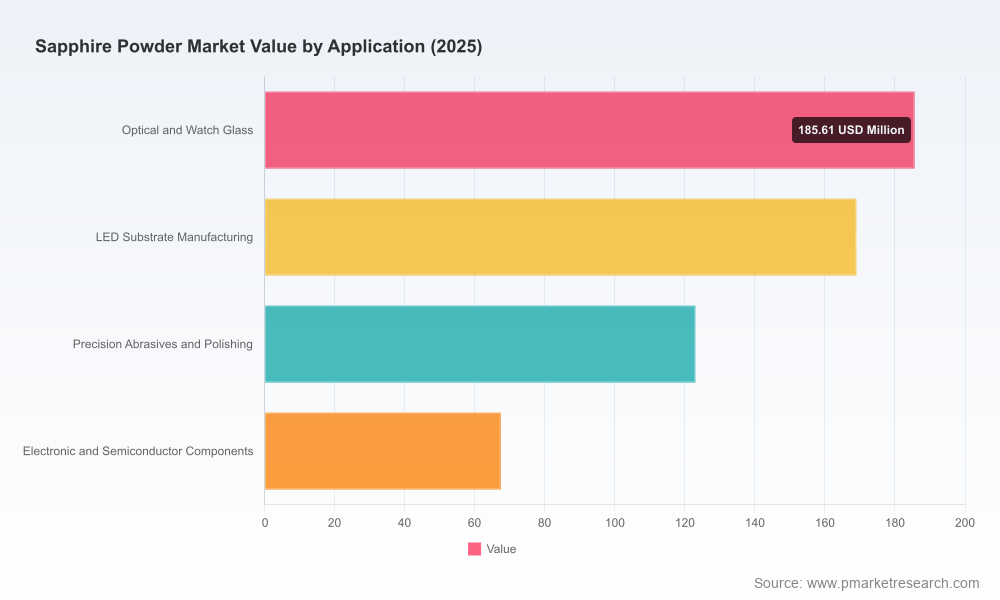
Three structural challenges currently define the market's crossroads. First, purity and trace-contamination control have become non-negotiable in high-end applications, particularly for semiconductor components sensitive to alpha emissions and for LED substrate manufacturing where defect density directly affects yield. Meeting stringent specifications consistently at commercial scale places heavy operational and technical demands on producers, shaping capital allocation and process investment. Second, energy intensity embedded in the upstream alumina value chain remains a persistent cost driver. Bauxite-derived alumina production routes consumed a substantial volume of global energy in recent years, feeding into price volatility and long-term cost planning for powder producers who rely on conventional feedstocks or energy-intensive refining steps. Third, demand is fragmenting across applications with divergent performance requirements. Optical and watch glass, LED substrate manufacturing, precision abrasives and polishing, and electronic and semiconductor components each impose distinct purity, particle morphology, and consistency thresholds, making one-size-fits-all production strategies increasingly suboptimal.
Sapphire Glass Market
Key Drivers Shaping the Market Trajectory
Technology Innovation and Breakthroughs
Process innovation is one of the most consequential forces reshaping the market. Proprietary production routes that reduce carbon content and control trace impurity profiles are enabling new grades of high-purity and ultra-high-purity alumina powders optimized for synthetic sapphire growth and advanced ceramics. These methods are not merely incremental improvements; they materially alter the relationship between feedstock properties and final crystal quality. Lower carbon and controlled alpha-phase characteristics help minimize defects in crystal growth cycles, improving downstream yield and reducing rework. In parallel, formulations tailored for chemical mechanical planarization slurries and semiconductor equipment coatings illustrate how powder specifications are increasingly co-designed with end-use applications rather than specified as generic material inputs.
The practical effect is a widening performance envelope for sapphire powder. Producers that can deliver reproducible purity, controlled particle characteristics, and application-specific formulations are gaining preferential access to qualification pipelines in demanding sectors. This trend is shifting competitive advantage away from volume-centric commodity logic and toward technical consistency, traceability, and application engineering. For buyers, it means that powder selection is increasingly a yield-and-reliability decision rather than a simple cost-per-kilogram comparison.
Policy, Regulation, and the Sustainability Imperative
Policy and regulatory expectations are weaving sustainability and material safety into procurement criteria. Ultra-high purity grades with demonstrably low impurity profiles and non-detect alpha emission characteristics are becoming necessary for semiconductors and other sensitive applications, aligning technical performance with regulatory and reliability standards. Beyond product specifications, the energy footprint of upstream production routes is attracting attention from both cost-conscious operations and sustainability-oriented procurement functions. Lower-emission production pathways, particularly those that reduce energy consumption and carbon output relative to conventional methods, are increasingly relevant because they influence total cost of ownership, supply chain resilience, and corporate decarbonization targets.
This regulatory and sustainability overlay does not simply add a compliance layer; it restructures the economics of qualification. When a production route lowers emissions while maintaining or improving purity, it can lower exposure to energy cost volatility and strengthen a supplier's position in applications where reliability and sustainability credentials are weighted in sourcing decisions. For market participants, the implication is clear: process innovation that addresses both performance and environmental impact creates a durable differentiator, especially in sectors where qualification cycles are long and switching costs are high.
Demand-Side Shifts in End-Use Markets
Demand dynamics are evolving as downstream industries pursue miniaturization, higher reliability, and optical performance. Synthetic sapphire continues to be valued for its hardness, transparency, and chemical resistance, but the specific requirements of each end-use segment are becoming more granular. LED substrate manufacturing, for example, depends on feedstock that supports consistent crystal quality at scale. Precision abrasives and polishing demand powders that balance cutting efficiency with surface finish. Optical and watch glass applications focus on clarity, durability, and reproducibility. Electronic and semiconductor components increasingly require ultra-pure, low-alpha materials to safeguard device performance and reliability.
Recent procurement signals underscore this tightening of specifications. Japanese semiconductor customers have upgraded letters of intent for high-purity alumina volumes, reflecting a deliberate increase in committed throughput for specialized grades. At the same time, demand from the sapphire sector for sintered high-purity alumina tablets has risen, indicating that downstream users are scaling up their qualified material bases to support higher production volumes and firm production schedules. These developments suggest that demand is not merely growing in aggregate; it is consolidating around qualified suppliers and specific high-purity forms that can be integrated into predictable manufacturing flows.
Supply Chain and Cost Structure Dynamics
Cost structures in the sapphire powder market are shaped by feedstock routes, energy usage, and the economics of specialty-grade production. Conventional bauxite-derived alumina pathways are energy-intensive and exposed to broader industrial energy dynamics, contributing to cost variability for producers who depend on those routes. By contrast, specialized production methods that improve purity and reduce certain emissions can alter the cost-performance balance in favor of higher-value grades, particularly where pricing reflects purity, phase control, and application readiness. The pricing spectrum for specialized high-purity alumina powders for sapphire growth and ceramics indicates meaningful differentiation: specialized grades command ranges that vary with purity and form, creating incentives for producers to invest in process control and grade-specific optimization rather than competing solely on bulk tonnage.
Supply chain resilience is also being reconfigured by qualification cycles and regional customer expectations. In applications where material consistency directly affects yield and device reliability, buyers prioritize suppliers with proven repeatability and documented quality attributes. This preference encourages longer-term commitments and volume upgrades, which in turn support capacity expansion and steady-state manufacturing. For producers, the strategic challenge lies in aligning capacity additions with qualified demand rather than speculative volume, ensuring that scale gains translate into margin-preserving, repeatable throughput.
Competitive Landscape and Leading Strategies
Distinctive Positioning Among Core Players
The competitive field features a mix of producers, crystal growers, and distributors, each pursuing differentiation through process ownership, grade specialization, and application alignment. One Canadian provider focuses on high-purity alumina powders optimized as feedstock for consistent, defect-free synthetic sapphire crystal growth, while also supplying tailored powders for technical ceramics. This positioning emphasizes repeatability and application fit, targeting customers who need feedstock that supports stable crystal growth cycles and reliable ceramic processing.
An Australian producer has built a strategy around ultra-high purity alpha-phase alumina powders and low-carbon synthetic sapphire materials, leveraging a proprietary solvent extraction process. Its product series includes high-sintering, low-alpha variants designed for demanding applications, and its positioning extends to materials for sapphire growth and related high-tech uses. The emphasis on proprietary process control and low-carbon outcomes indicates a dual strategy: capturing value in high-specification grades while aligning with sustainability considerations that increasingly influence procurement. A U.S.-based supplier producing high-purity alumina via an enhanced Bayer process targets sapphire and ruby crystal growth, alongside advanced ceramic and high-temperature applications. Its approach underscores the continued relevance of established refining routes when paired with enhancements that meet specific purity and consistency needs.
Steel Powder Market
A Polish crystal grower with a refining subsidiary focuses on ultra-pure feedstock for high-quality sapphire crystal production in LED and semiconductor applications, highlighting the integration of source material preparation with crystal growth expertise. This vertical alignment can reduce variability and strengthen qualification readiness for end uses where feedstock quality directly affects crystal performance. Finally, a U.S. distributor with global reach supplies high-purity sapphire materials, including powders for research and industrial applications in advanced ceramics and optics. Distributors of this kind serve as critical access points for prototyping, research-scale demand, and multi-region supply, bridging specialized producers and diverse end users.
Strategic Differentiation and Competitive Evolution
Across these participants, differentiation is increasingly coupled to three attributes: process ownership that controls purity and impurity profiles; grade specialization that matches specific end-use requirements; and qualification readiness that shortens or stabilizes integration cycles for demanding customers. The market's top-heavy concentration indicates that scale and established relationships matter, but they are not sufficient on their own. As specifications tighten and sustainability expectations rise, the ability to deliver traceable, application-tuned materials with reproducible quality is becoming a decisive advantage.
Market evolution is showing signs of both consolidation and targeted differentiation. On one hand, larger producers and integrated players are expanding capacity and securing long-term volume commitments, reinforcing positions in applications where qualification cycles favor incumbents. On the other hand, specialists are carving out defensible niches by offering grades with unique purity, phase, or emission characteristics, or by aligning production with lower-emission profiles that appeal to cost- and sustainability-conscious buyers. New entrants are likely to face steep qualification hurdles in the most demanding segments, while opportunities may emerge in research-oriented distribution, regional service capacity, and specialized grades that are underserved by bulk-oriented producers.
Forward-Looking Trends: The Next 3-5 Years
The coming years are likely to be defined by closer coupling between material specifications and end-use performance, expansion of capacity anchored in qualified demand, and rising importance of sustainability-linked process advantages. Several trends stand out.
- Application-specific purity and phase control will become standard expectations in high-value segments. Buyers in semiconductor, LED substrate, and optical applications are likely to require documented impurity profiles, low-alpha characteristics, and consistent particle behavior. Suppliers that can deliver these attributes with reproducible quality will capture a disproportionate share of value-added demand, while generic-grade supply may face margin pressure.
- Capacity expansion will increasingly follow committed, qualified demand rather than speculative volume. Recent volume upgrades and investment in large-scale single-site manufacturing indicate that participants are aligning growth with secured orders and application qualification pipelines. This pattern supports steadier utilization and reduces the risk of capacity overhang, but it also raises the importance of forecasting accuracy and customer development.
- Lower-emission, energy-efficient production routes will gain strategic relevance. As energy costs and sustainability criteria influence sourcing decisions, processes that reduce emissions relative to traditional methods will offer both cost and market-positioning benefits. This advantage is particularly salient for producers targeting customers with explicit decarbonization goals or energy cost sensitivity.
These trends translate directly into commercial opportunities. For producers, there is room to expand premium-grade lines where specifications are stringent and switching costs are high, especially where process innovation supports both performance and sustainability. For buyers, the opportunity lies in securing qualified supply earlier in product development cycles, locking in consistency, and reducing exposure to qualification delays. For investors, the attractive thesis centers on participants with proprietary process control, application-aligned grades, and credible pathways to lower emissions and stable utilization.
Potential risks and uncertainties should be acknowledged. Qualification cycles can extend timelines for new grades, and any deviation in purity or consistency can trigger re-qualification costs and supply disruptions. Energy and feedstock costs remain exposed to broader industrial dynamics, affecting margins for routes that do not mitigate these exposures. Demand patterns across applications may diverge further, complicating portfolio strategies that rely on balanced cross-segment volume. Finally, regulatory expectations around emissions and material safety may evolve, requiring ongoing adaptation in production and documentation.
Strategic Implications for Decision-Makers
Different stakeholders face distinct but interconnected priorities in this market.
For manufacturers and crystal growers: invest in feedstock qualification as a core reliability function. The consistency of powder purity, phase characteristics, and particle behavior directly affects yield and downstream performance, particularly in LED and semiconductor applications. Prioritize suppliers with documented quality attributes and reproducible processes, and consider early engagement during product development to align specifications before scale-up. Where feasible, diversify across qualified sources to mitigate single-supplier risk without sacrificing consistency.
For investors and strategic stakeholders: focus on process ownership, grade specialization, and demand foundations. The most resilient positions tend to combine proprietary production methods that control purity and emissions with committed, qualified demand in high-value applications. Evaluate expansion plans for their alignment with secured orders and qualification pipelines, and assess whether pricing power in specialized grades supports the economics of capacity additions. Be attentive to energy intensity and cost volatility in upstream routes, which can influence margin stability over the forecast period.
For procurement and supply chain leaders: treat sapphire powder as a strategic input rather than a commodity. Total cost of ownership should incorporate qualification risk, yield impact, and sustainability criteria alongside unit price. Where applications are sensitive to contamination or alpha emissions, prioritize grades with verified purity and emission profiles. Build relationships that support traceability and consistent supply, and monitor capacity and demand signals that may affect lead times or availability in specialized grades. Align sourcing strategies with corporate sustainability objectives where low-emission production routes can reinforce both cost and compliance goals.
Timely access to detailed market intelligence is valuable because the strategic stakes are shifting quickly. Purity expectations, sustainability criteria, and demand commitments are evolving in tandem, and the gap between generic supply and application-tuned, qualified material is widening. Decision-makers who understand the interplay between process innovation, qualification dynamics, and end-use requirements are better positioned to choose suppliers, plan capacity, and time investments with confidence.
For a complete, granular view of market sizing by purity level, application, and region—along with company profiles, recent developments, pricing context, and scenario-based forecasts—the full PW Consulting report provides the detailed breakdowns and tailored recommendations needed for execution-level decisions.
For detailed analysis of this topic, please visit the official page: Worldwide Sapphire Powder Market
Lacy Lee
Senior Marketing Manager
sales@pmarketresearch.com
00852-95632430
PW Consulting: www.pmarketresearch.com
More Posts


Report This Post
Please complete the following requested information to flag this post and report abuse, or offensive content. Your report will be reviewed within 24 hours. We will take appropriate action as described in Findit terms of use.
