


Right Now

Strategic Trends and Commercial Opportunities in the Worldwide Paper Cup Sleeve Market
Market Snapshot and Core Challenges
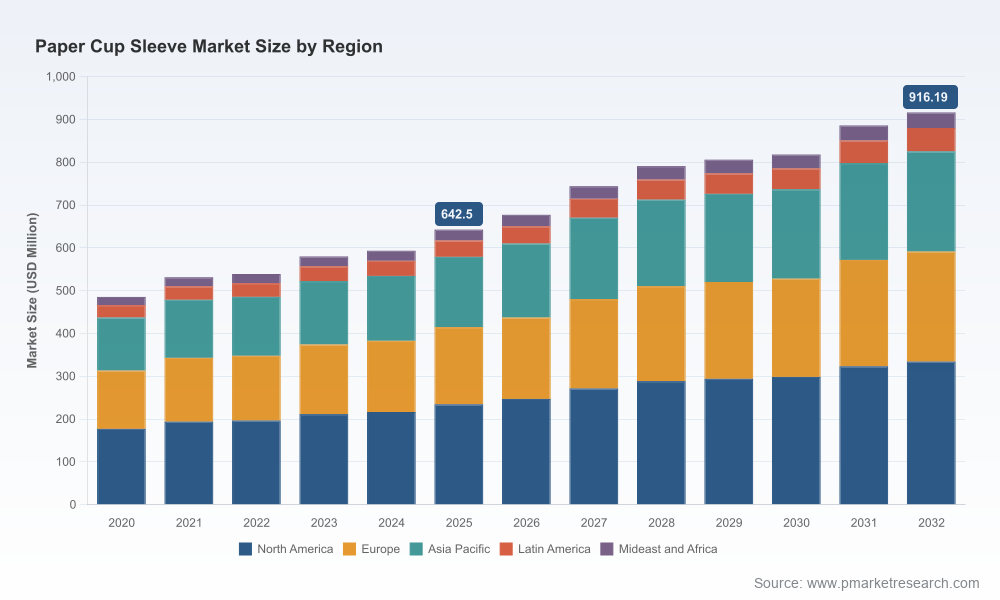
The global paper cup sleeve market has demonstrated steady expansion over the past half-decade, reaching an estimated valuation of USD 642.5 million in 2025. The trajectory from 2020 through 2025 reflects a compound annual growth rate that positions the sector for continued scaling, with projections indicating a rise to approximately USD 916.19 million by 2032. This growth path underscores a fundamental shift in how hot beverage handlers balance thermal performance, supply economics, and environmental accountability. While volume expansion is evident, the market is simultaneously navigating structural friction points that will define competitive advantage over the next several years.
One of the most pressing challenges lies in the fragmentation of regulatory expectations across major trade regions. Manufacturers and brand owners are no longer operating under a single compliance framework; instead, they must reconcile divergent packaging waste mandates, extended producer responsibility schemes, and recyclability benchmarks that vary by jurisdiction. This regulatory mosaic increases compliance overhead and complicates product standardization across global supply chains. Companies that treat regulatory adaptation as a localized cost center rather than a design input risk margin erosion and delayed market entry.
Disposable Paper Cup Market
A second challenge centers on raw material volatility and its transmission through cost structures. Paper cup sleeves rely heavily on kraft paper and corrugated paperboard to deliver thermal insulation and structural durability. Recent reporting indicates that kraft paper pricing has diverged significantly by region, with material costs in China tracked at approximately USD 891 per metric ton while French markets have seen figures around USD 1462 per metric ton. Such dispersion creates uneven cost bases, complicates sourcing strategies, and places pressure on margins for producers operating across multiple geographies. Without flexible procurement models and regionalized production footprints, firms face heightened exposure to price shocks and logistics inefficiencies.
A third challenge emerges from consumer and operator expectations around performance and sustainability converging simultaneously. End users increasingly expect sleeves that provide reliable thermal protection while aligning with broader environmental values. At the same time, coffee shops, quick service restaurants, and institutional buyers are under pressure to streamline packaging portfolios, reduce waste, and meet corporate sustainability targets. This dual demand forces manufacturers to optimize for insulation, print fidelity, recyclability, and compostability in a single product architecture, raising the bar for engineering and material selection.
Key Drivers Shaping Market Evolution
Technological innovation continues to reshape what paper cup sleeves can deliver beyond basic insulation. Advances in fiber-based design, surface treatment, and embossing techniques are enabling sleeves that improve heat dissipation control while preserving fold integrity and print quality. Recent product developments highlight this direction: a new line of fully compostable paper cups with plant-based lining was introduced, complementing insulated sleeve offerings for cafes and chains. This type of integrated solution signals a broader industry move toward end-to-end material compatibility, where sleeves and cups are designed to function as a unified system rather than mismatched components. For manufacturers, the opportunity lies in engineering sleeves that enhance thermal performance without sacrificing downstream recyclability or compostability.
Policy and regulatory dynamics are accelerating redesign cycles across the market. In Europe, the Packaging and Packaging Waste Regulation entered into force in February 2025 and will apply from August 2026, mandating extended producer responsibility schemes with fees modulated by recyclability for packaging including paper products. In the United States, seven states have enacted packaging extended producer responsibility laws covering paper products and foodservice ware, with reporting and fees now required. California’s SB 54 further raises the stakes by requiring 100% of single-use packaging and food service ware to be recyclable or compostable by 2032. These regulations are not merely compliance checkpoints; they are reshaping product architecture, material sourcing, and end-of-life planning. Firms that embed recyclability and compostability into sleeve design early gain a structural advantage in fee modulation, customer alignment, and future-proofing.
Demand-side behavior is reinforcing these regulatory and technological shifts. Consumers and corporate buyers are increasingly linking packaging choices to brand reputation and sustainability performance. Coffee shops and quick service restaurants are seeking sleeve solutions that support thermal comfort for customers while simplifying waste streams and meeting internal ESG commitments. This behavior creates pull for sleeves that combine insulation, clean print surfaces for branding, and material profiles compatible with recycling or composting infrastructure. The trend also encourages customization, as brands look for sleeves that reinforce identity without compromising environmental targets. In practice, this means demand is growing for designs that balance functional performance with clear sustainability signaling.
Supply chain and cost structure changes are adding another layer of strategic importance. Regional price divergence in kraft paper is encouraging producers to reconsider sourcing concentration, inventory buffers, and production location decisions. At the same time, cooperative initiatives are emerging to address end-of-life challenges at scale. A closed-loop recycling initiative for paper cups and sleeves was introduced in collaboration with municipalities to support circular economy goals. Such programs illustrate how supply chain actors are beginning to coordinate with local authorities and downstream processors to improve recovery rates and material circularity. For manufacturers, this points to a future where procurement, design, and recovery planning are increasingly integrated rather than managed in isolation.
Competitive Landscape and Leading Strategies
The market remains relatively unconcentrated, with a combined top-three share of approximately 18.5% and a top-five share near 24.2%. This structure indicates room for both specialized players and broader packaging manufacturers to compete on design, regional presence, and sustainability credentials. The competitive field spans large multinationals with diversified foodservice portfolios and smaller firms focused on customization, branding, and regional export flows.
Global packaging leaders are leveraging scale, fiber-based material expertise, and sustainability messaging to anchor their positions. Huhtamäki, based in Espoo, Finland, offers insulated paper cup sleeves within a sustainable foodservice packaging portfolio, including options with recycled content designed for hot beverage insulation across global markets. Its early 2025 launch of a fully compostable paper cup line with plant-based lining demonstrates a strategy of extending sleeve compatibility into broader system-level solutions. Graphic Packaging International, headquartered in Atlanta, Georgia, manufactures paper-based packaging solutions including cup sleeves for beverage service, emphasizing sustainable fiber-based materials. Pactiv Evergreen, located in Lake Forest, Illinois, supplies paper cup sleeves and related foodservice disposables, including lines with sustainable attributes for hot drink applications. These companies benefit from integrated material science capabilities, established foodservice relationships, and the ability to align sleeve design with broader sustainability narratives.
Regional and application-focused players are carving out differentiated niches. Dart Container, based in Mason, Michigan, provides paper and insulated cup sleeves for hot beverages, focusing on foodservice and quick-service restaurant applications with thermal protection solutions. Its partnership with a leading U.S. coffee retailer for customized insulated paper cups and associated sleeve solutions highlights a strategy centered on co-developed performance and recyclability. Benders, headquartered in Wellingborough, UK, produces paper cups and complementary paper cup sleeves using sustainably sourced materials with FSC certifications, reinforcing a provenance and certification-based value proposition.
Worldwide Insulated Cup Sleeves Market
In the export and customization segment, Chinese manufacturers and U.S.-based branding specialists are expanding their roles. Zhejiang Pando EP Technology, based in Zhejiang, China, specializes in wholesale paper sleeves for coffee cups, including kraft and custom options, with exports to Europe, the US, and other regions. Suzhou Accum Packaging, also in Suzhou, China, manufactures custom paper cup sleeves with design flexibility for food and beverage packaging, holding FSC and ISO certifications. In the US, HotShot Sleeves focuses on custom printed paper coffee sleeves and related beverage packaging for branding, while Ibex Packaging supplies custom printed paper cup sleeves tailored for branding and insulation needs. LBP Manufacturing, also in the US, offers insulated paper cup sleeves designed for hot beverage thermal protection in foodservice. These players compete on design agility, print customization, regional cost structures, and the ability to respond quickly to brand-specific requirements.
The competitive landscape is evolving along two converging paths. On one side, larger manufacturers are expanding system-level offerings that pair sleeves with cups, linings, and recovery programs, leveraging scale and sustainability credentials. On the other, customization-focused firms are deepening their value in branding, rapid design iteration, and regional sourcing flexibility. Market integration is likely to continue where sustainability mandates and thermal performance requirements raise the cost of standalone competition, while fragmentation will persist in segments where localized pricing, print differentiation, and export opportunities reward speed and flexibility. New entrants can gain traction by addressing specific regulatory profiles, offering compostable or recycled-content options, or delivering branding-centric solutions that align with operator ESG goals.
PW Consulting
Forward-Looking Trends and Commercial Opportunities
Over the next three to five years, one dominant trend will be the normalization of recyclability and compostability as baseline design requirements rather than optional enhancements. As extended producer responsibility schemes with modulated fees take hold and single-use packaging mandates tighten, sleeve designs that support recovery and composting will gain preferential treatment in both cost structures and customer preferences. Commercial opportunity will accrue to manufacturers that can deliver thermal performance while maintaining material streams compatible with existing recycling or composting infrastructure. Brands that adopt such sleeves can also reduce long-term compliance exposure and strengthen sustainability messaging.
A second trend will be the growing emphasis on system-level packaging solutions that align cups, sleeves, and linings. Integrated designs reduce friction in thermal protection, simplify end-of-life handling, and enable more coherent sustainability claims. This creates opportunities for suppliers that can co-develop solutions with coffee chains, quick service restaurants, and institutional buyers, particularly where customization and performance can be balanced within a unified material strategy. Companies that position themselves as partners in solution design, rather than component vendors, are better placed to capture long-term contracts and influence specification standards.
A third trend will be regional cost optimization and supply chain reconfiguration. With kraft paper prices varying widely across markets and regulatory requirements differing by jurisdiction, producers will increasingly favor regionalized production, flexible sourcing, and inventory strategies that absorb volatility. At the same time, municipal and cooperative recovery initiatives are likely to expand, creating new touchpoints between manufacturers, brands, and local authorities. Commercial opportunities will emerge for firms that can map material flows accurately, align sourcing with regional regulatory profiles, and participate in recovery ecosystems that improve circularity and reduce downstream friction.
These trends carry inherent risks and uncertainties. Regulatory timelines and fee structures may shift as implementation details are clarified, creating compliance uncertainty for product roadmaps. Material availability and price dispersion could persist, especially if fiber supply tightens or trade dynamics change. End-of-life infrastructure remains uneven across regions, meaning that even well-designed compostable or recyclable sleeves may face limited recovery in certain markets. Finally, brand differentiation through customization can pressure margins if print complexity, short runs, and rapid iteration are not managed with disciplined cost control. Strategic planners should treat these uncertainties as variables to model rather than fixed assumptions.
Strategic Recommendations for Decision-Makers
For manufacturers, the priority is to embed sustainability and thermal performance into a single design framework that can adapt to multiple regulatory environments. This means evaluating fiber choices, surface treatments, and end-of-life compatibility as interconnected decisions rather than separate workstreams. Companies should also assess regional production and sourcing options to mitigate price dispersion and improve responsiveness to local compliance requirements. Building partnerships with recovery programs and municipal initiatives can further strengthen circularity claims and reduce downstream risk. Where customization is part of the offering, disciplined cost management and design standardization will be essential to preserve margins while meeting branding demands.
For investors, the market presents opportunities in manufacturers and brand-aligned suppliers that can demonstrate regulatory readiness, material innovation, and system-level integration. Due diligence should focus on exposure to extended producer responsibility fees, recyclability and compostability positioning, and the ability to operate across regions with divergent material costs. Companies that combine scale with design agility, or that have established relationships with foodservice chains and recovery ecosystems, are better positioned to capture value as mandates tighten and sustainability expectations rise. Monitoring regional regulatory implementation and material price trends will be critical to timing commitments and assessing margin resilience.
For procurement teams and brand owners, the focus should be on specifying sleeves that align thermal performance with long-term compliance and waste management goals. This includes evaluating supplier capabilities for recycled content, compostable or recyclable design, and compatibility with local recovery infrastructure. Collaborative engagement with suppliers on customization, print efficiency, and insulation requirements can reduce total cost while supporting sustainability targets. Procurement strategies should also account for regulatory trajectory, ensuring that selected solutions remain viable as extended producer responsibility schemes and single-use packaging mandates evolve.
Keeping pace with these shifts requires continuous visibility into regulatory timelines, material pricing, competitor moves, and end-of-life infrastructure development. Detailed segment data, regional cost mapping, and scenario-based planning can sharpen decision-making and reduce exposure to unexpected compliance or supply shocks. For a broader, data-rich view of market sizing, segmentation dynamics, competitive positioning, and forward scenarios, refer to the full PW Consulting report on the worldwide paper cup sleeve market, which provides deeper granularity for tailored strategic planning.
For detailed analysis of this topic, please visit the official page: Worldwide Paper Cup Sleeve Market
Lacy Lee
Senior Marketing Manager
sales@pmarketresearch.com
00852-95632430
PW Consulting: www.pmarketresearch.com
More Posts


Report This Post
Please complete the following requested information to flag this post and report abuse, or offensive content. Your report will be reviewed within 24 hours. We will take appropriate action as described in Findit terms of use.
