


Right Now

The L6 and L7 Quadricycles Market: Strategic Trends and Commercial Opportunities in Urban Micro-Mobility
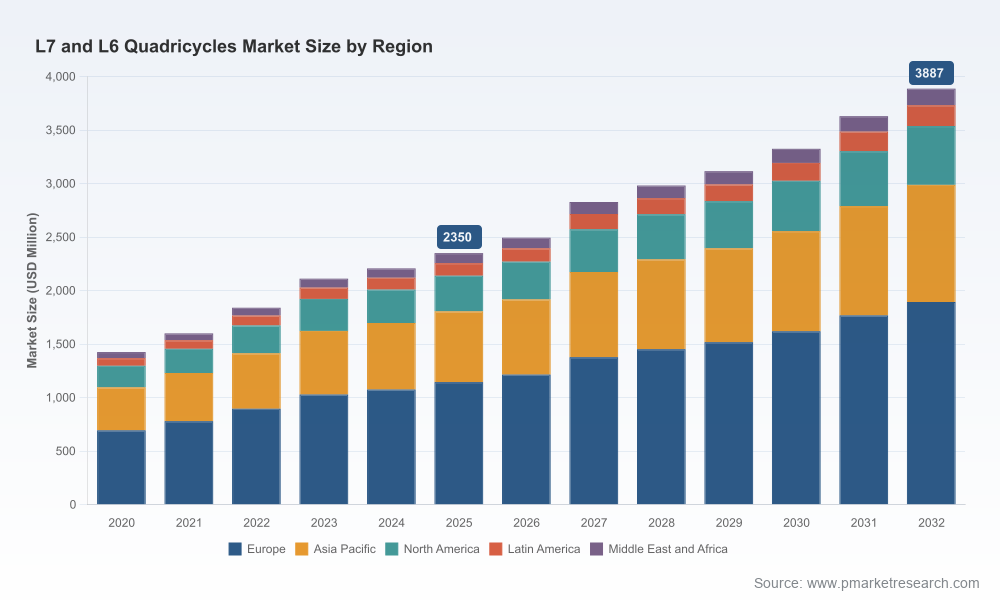
The global market for L6 and L7 quadricycles has evolved from a niche regulatory alternative into a structurally significant segment of urban mobility and light commercial transport. Defined by European technical frameworks that classify L6e light quadricycles and L7e heavy quadricycles by weight, power, and speed thresholds, these vehicles occupy a strategic middle ground between motorcycles, compact cars, and specialized utility platforms. With a projected revenue trajectory climbing toward nearly four billion USD by the early 2030s and a sustained compound annual growth rate of 7.45 percent across the forecast horizon, the segment reflects broad-based adoption rather than speculative hype. The growth is anchored in measurable shifts in licensing accessibility, electrification economics, and municipal procurement patterns, while simultaneously testing manufacturers on supply chain resilience, regulatory adaptation, and product differentiation. For executives, investors, and procurement leaders, the quadricycle market now represents a tangible intersection of decarbonization mandates, last-mile logistics optimization, and license-free personal mobility. Understanding where the market is heading requires looking past headline volumes and examining the structural forces reshaping competitive positioning, cost curves, and demand composition.
Market Landscape and Core Challenges
A Reshaped Growth Arc
The segment’s expansion over the past half-decade demonstrates consistent upward momentum, with revenue scaling from mid-2020 levels to a base-year valuation of approximately 2.35 billion USD in 2025. The forward curve indicates continued acceleration through the late 2020s, supported by cumulative demand in both personal and commercial applications as well as regional depth across established European markets and emerging adoption zones. Rather than a linear lift driven by a single catalyst, the growth profile reflects overlapping tailwinds: electrification adoption curves compressing time-to-market for new models, urban congestion and parking constraints reinforcing the appeal of compact vehicles, and commercial fleet operators seeking lower total cost of ownership alternatives for intra-city operations.
Importantly, the market no longer behaves as a monolithic category. The L6 and L7 classifications have diverged in use-case emphasis, with lighter L6 platforms increasingly aligned to personal and lightweight commercial mobility, while heavier L7 configurations are gaining traction where payload, range, or regulatory permission profiles justify a higher-performance footprint. This divergence is reshaping product roadmaps, inventory strategies, and after-sales service models, requiring manufacturers and buyers to evaluate quadricycles not as a single vehicle class but as a portfolio of purpose-built mobility solutions.
Structural Pressures at the Current Inflection Point
Despite constructive momentum, the segment faces a set of challenges that will determine which players capture sustainable share and which get squeezed by margin compression or compliance friction.
- Electrification transition and platform economics: The rapid shift toward electric drivetrains is compressing development cycles and demanding new investments in battery integration, thermal management, and charging compatibility. Manufacturers that remain heavily reliant on internal combustion architectures face margin pressure from parts obsolescence, while those accelerating EV platforms must manage volatility in battery input costs and validate durability in dense urban duty cycles.
- Regulatory complexity across jurisdictions: Quadricycle definitions and licensing rules can vary materially by country and region, even within markets that share the same European regulatory foundation. Differences in minimum age requirements, license categories, road access privileges, and municipal usage restrictions create fragmentation that complicates pan-European scaling and creates hidden costs in localization, homologation, and dealer training.
- Competitive intensity and margin discipline: The category attracts both specialist quadricycle manufacturers and broader mobility groups leveraging micro-vehicle portfolios for urban positioning. As more players enter with electric variants, price transparency increases and differentiation becomes harder to sustain purely on badge or design. Companies must compete on total cost of ownership, service coverage, utility configuration, and fleet integration capabilities rather than specification sheets alone.
Core Drivers Reshaping Demand and Supply
Electrification as the Dominant Platform Shift
Electrification is no longer an optional product variant; it is increasingly the default configuration in new quadricycle development. Recent market data from early 2025 indicates that a large majority of new quadricycle sales in key European markets were fully electric, signaling that buyer expectations, fleet specifications, and municipal procurement criteria are converging around zero-emission platforms. This shift is driven by a combination of factors: lower operating costs for high-utilization commercial use, tightening urban emissions expectations, and improving battery energy density that makes light vehicle electrification more practical at reasonable weight and cost.
The strategic implication is that the competitive battlefield has moved from whether to electrify to how to electrify efficiently. Manufacturers are pursuing different routes: some are adapting existing L6 and L7 architectures with retrofitted electric drivetrains, while others are building dedicated EV platforms optimized for packaging, range consistency, and serviceability. The divergence in approach matters because it affects not only upfront pricing but also residual value, charging behavior, maintenance intervals, and the ability to tailor vehicles for commercial payloads or passenger comfort.
Regulatory Architecture and Licensing Accessibility
Regulation continues to function as both an enabler and a boundary condition for the market. The technical framework governing L6 and L7 quadricycles sets clear performance and mass parameters, creating a defined product space within which manufacturers can innovate. At the same time, driver licensing and access rules influence demand elasticity by shaping who can operate these vehicles and where they can be used. In many EU contexts, lighter quadricycles can be operated under broader license availability and lower age thresholds, expanding the addressable user base for personal mobility and light delivery applications. Heavier configurations typically carry different licensing expectations, which directs them toward use cases where the operational benefits justify the additional regulatory requirements.
The commercial relevance lies in the fact that regulatory clarity can accelerate adoption, while patchwork national implementation can slow it. Municipal fleets, rental operators, and corporate mobility managers increasingly evaluate quadricycles as part of compliance-driven or sustainability-linked programs. Where local authorities streamline access and align procurement with low-emission urban plans, demand can scale quickly, as evidenced by recent municipal fleet supply activity. Conversely, ambiguous road access rules or inconsistent enforcement can limit practical utility, especially for commercial operators that depend on predictable routing and operational continuity.
Commercial Fleet Economics and Urban Utility Demand
One of the most durable demand drivers is the commercial economics of urban and suburban utility operations. Quadricycles offer a compelling value proposition for applications where full-size vans or trucks are inefficient in terms of parking, maneuvering, congestion exposure, and operating cost. For municipal services, logistics operators, facility management, and localized service businesses, L7 utility platforms in particular can provide a lower-cost, lower-footprint alternative for frequent short-haul tasks.
This dynamic is reinforced by total cost of ownership calculations that increasingly favor electric platforms when utilization is high and duty cycles are predictable. Lower fuel and maintenance exposures, combined with potential access advantages in restricted urban zones, make quadricycles attractive for fleets that operate within defined geographic footprints. The trend is not limited to large logistics players; it also extends to municipal bodies seeking practical vehicles for urban services, where recent contract activity has demonstrated real-world commitment to scaling electric quadricycle fleets for civic operations.
Supply Chain Realignment and Cost Structure Pressures
The market’s growth is also being shaped by the reconfiguration of supply chains and component sourcing. Electric quadricycles depend on battery packs, power electronics, motors, and specialized chassis integration, which means manufacturers are increasingly sensitive to component availability, supplier concentration, and input cost fluctuations. At the same time, the smaller vehicle form factor can create advantages in material efficiency and production scale if manufacturers design for modularity and shared components across models.
Strategic responses vary. Some organizations are pursuing partnerships or acquisitions to secure electrification expertise, platform rights, or expanded distribution reach. Others are focusing on vertical integration in critical subsystems or aligning with Tier-1 suppliers that can support fleet-scale production and service spares. The overarching trend is that cost structure competitiveness will increasingly depend on engineering discipline, supply chain flexibility, and the ability to standardize high-value components without sacrificing application-specific utility.
Competitive Positioning and Emerging Industry Dynamics
Specialists, Intermediaries, and Broader Mobility Players
The competitive landscape combines established quadricycle specialists with broader mobility and vehicle groups that treat L6 and L7 platforms as part of a wider urban mobility or commercial vehicle strategy. Specialist manufacturers often compete on category familiarity, application-specific tuning, and brand recognition within European quadricycle segments. Their advantage typically lies in refined product knowledge, targeted utility configurations, and dealer networks accustomed to L-category service requirements.
At the same time, larger mobility-oriented players bring scale, electrification experience, and the ability to position quadricycles alongside broader micro-mobility portfolios. This can create advantages in battery procurement, platform sharing, marketing reach, and integration with shared-use or fleet-management ecosystems. The presence of both specialist and scaled competitors creates a market structure where differentiation is increasingly achieved through application fit, fleet service capabilities, and electrification execution rather than through category ownership alone.
Differentiation Strategies Gaining Traction
Several strategic moves illustrate how leading participants are seeking durable advantage in a tightening market.
- Platform co-development and electrification partnerships: Strategic alliances are being used to accelerate EV platform development and share engineering risk. Collaborations targeting advanced battery and motor integration reflect an industry-wide recognition that electric quadricycle competitiveness depends on systemic optimization rather than isolated component swaps.
- Utility-led commercial expansion: Manufacturers specializing in electric utility quadricycles are positioning around municipal, industrial, and commercial workflows. Securing large municipal supply contracts not only provides near-term revenue but also reinforces credibility for future fleet tenders and public-sector adoption.
- Portfolio expansion through acquisition: Some players are expanding electrification portfolios by acquiring relevant European operations, signaling a move toward broader L-category coverage and deeper electric model lines. Acquisition activity can also consolidate engineering capacity and distribution access in markets where brand presence and service coverage matter.
- Product refresh and model visibility: Redesigned models and renewed electric variants presented at major industry events highlight the importance of freshness in a category where buyer perception is influenced by both utility and modern design cues. Refreshed platforms can support resale value, fleet appeal, and consumer interest in personal-use variants.
Market Structure: Consolidation Pressure and Niche Proliferation
The market appears to be evolving along two concurrent paths. First, consolidation pressure is emerging wherever electrification, homologation, and fleet service requirements create scale advantages. Larger groups and well-capitalized specialists are better positioned to absorb development costs, invest in battery-integrated platforms, and maintain pan-regional service coverage. Second, there is continued room for niche differentiation in areas such as high-end personal quadricycles, adventure-oriented variants, and specialized commercial configurations that address narrowly defined workflows.
For buyers and investors, this means the market is not converging into a single winner-takes-all structure. Instead, it is becoming more segmented by application, with leaders potentially emerging at the intersection of electrification capability, commercial utility fit, and regional service strength. New entrants may find opportunity in targeted segments rather than in broad undifferentiated competition, especially where they can bring a distinct cost model, drivetrain approach, or application-specific design.
Forward Outlook: Three Trends to Watch
Electric Quadricycles Becoming the Default Commercial and Personal Baseline
Over the next three to five years, electric configurations are likely to become the prevailing baseline across much of the L6 and L7 market in Europe and other regions with supportive regulatory and charging environments. This will not eliminate internal combustion options entirely, but it will shift the center of gravity toward EV platforms in new product introductions, fleet specifications, and municipal procurement. The commercial opportunity lies in aligning product planning, service infrastructure, and customer education with an electric-first reality, while managing the transition for markets where charging access or grid constraints slow adoption.
The related risk is uneven regional readiness. Markets with limited charging infrastructure, higher electricity costs, or less favorable incentive structures may experience slower EV conversion, creating demand fragmentation that requires region-specific product and pricing strategies.
Municipal and Commercial Fleet Procurement as a Growth Accelerator
Public-sector and commercial fleet adoption is poised to become a stronger growth lever, particularly for L7 utility platforms. As cities and businesses seek practical low-emission mobility tools for localized operations, quadricycles can serve as cost-effective assets for service rounds, micro-logistics, and internal-site transport. Larger fleet contracts can provide manufacturers with volume stability and a platform for recurring aftersales revenue, while also raising the importance of durability, serviceability, and asset management features.
The uncertainty here lies in procurement cycles and budget prioritization. Municipal decisions can be influenced by political cycles, infrastructure plans, and competing mobility investments. Commercial adoption may accelerate in some verticals and lag in others depending on labor constraints, fuel economics, and the availability of viable charging or swapping solutions.
Application Segmentation Driving Product and Business Model Diversification
The market is likely to continue bifurcating by purpose: lighter personal-use quadricycles optimized for urban commuting, and heavier commercial variants engineered for payload, duty-cycle resilience, and fleet integration. This segmentation will encourage more specialized configurations, including cargo-focused L7 platforms, shared-use variants, and premium personal models. It may also encourage new business models such as subscription access, fleet leasing, and service bundles that combine vehicle supply with charging coordination or maintenance packages.
A key risk is over-fragmentation. If product variation expands too broadly without sufficient scale in core architectures, manufacturers can face rising engineering and inventory complexity. The winners are likely to be those who balance segment-specific customization with disciplined platform sharing and clear application positioning.
PW Consulting Automotive & Machinery Research Center
Strategic Actions for Decision Makers
For Manufacturers and Product Leaders
Organizations operating in or entering the L6 and L7 space should prioritize electrification platform discipline and application clarity. This means making deliberate choices about which segments to serve with dedicated architectures versus adapted platforms, and ensuring that battery integration, thermal management, and service access are treated as core product attributes rather than afterthoughts. It also means building or securing supply relationships that can support repeatable production and service spares at scale. Where scale advantages are real, partnerships, selective acquisitions, and platform collaborations can help reduce time-to-market risk and strengthen competitive positioning.
For Investors and Capital Allocators
Investment decisions in this segment should be guided by the ability to execute across electrification, regulatory navigation, and fleet or distribution reach rather than by brand heritage alone. Valuations and growth prospects will increasingly depend on whether a company can convert EV transitions into durable margin structures, secure recurring fleet or municipal demand, and operate efficiently across multiple jurisdictions. Investor diligence should pay close attention to platform strategy, supplier concentration, homologation exposure, and the company’s capacity to serve commercial utility workflows as distinct from personal-use sales cycles.
For Commercial Buyers and Procurement Teams
Procurement leaders evaluating quadricycles for fleet or municipal use should assess total cost of ownership across the asset lifecycle, including energy costs, maintenance patterns, residual value expectations, and servicing availability in the operating region. Vehicle selection should be matched to actual duty cycles, payload needs, and access constraints rather than to general category appeal. Where possible, buyers should seek suppliers that can provide predictable service coverage, spare-part availability, and fleet integration support, since these factors often determine long-term operating reliability more than headline specifications.
Motorized Quadricycles Market
Conclusion
The L6 and L7 quadricycle market is entering a phase where growth is supported by structural demand shifts rather than transient interest. Electrification, licensing accessibility, urban utility economics, and supply chain realignment are together redefining what these vehicles are used for and who buys them. At the same time, regulatory fragmentation, margin pressure, and platform transition costs are creating a more demanding competitive environment that rewards disciplined execution.
For organizations evaluating participation in this segment, the most valuable next step is to move from broad category awareness to application-specific and region-specific intelligence. Detailed segmentation data, localized regulatory interpretation, electrification cost modeling, and competitive benchmarking can materially improve product planning, investment decisions, and procurement strategies. Targeted research that ties market size and growth trajectories to operational realities offers a clearer path to capturing the opportunities embedded in the segment’s next expansion cycle.
Low Speed Vehicle Market
For detailed analysis of this topic, please visit the official page: L7 and L6 Quadricycles Market
Lacy Lee
Senior Marketing Manager
sales@pmarketresearch.com
00852-95632430
PW Consulting: www.pmarketresearch.com
More Posts


Report This Post
Please complete the following requested information to flag this post and report abuse, or offensive content. Your report will be reviewed within 24 hours. We will take appropriate action as described in Findit terms of use.
