

Right Now

Designing a Large Livestock Feed Mill Plant
A large livestock feed plant requires more than high-capacity pelletizing equipment. The entire facility must be designed around continuous material movement, reliable production, product storage, and efficient management.
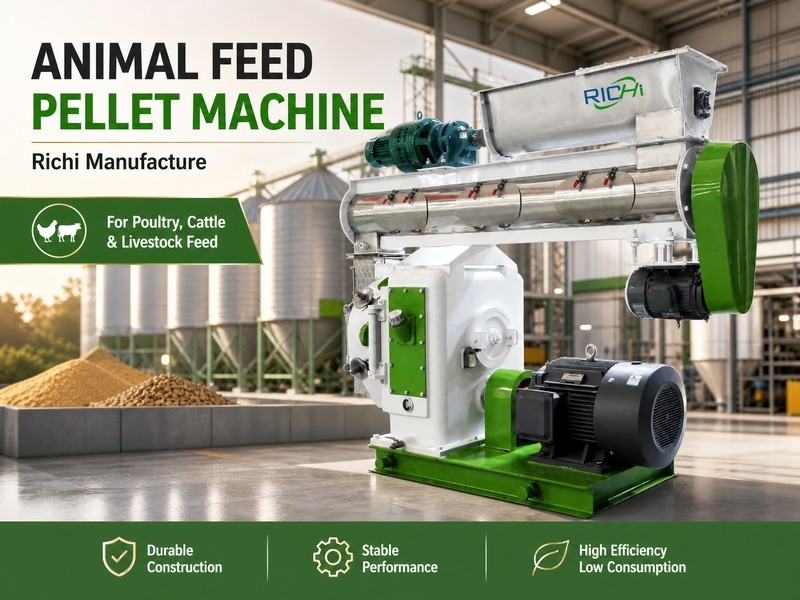
A large scale animal feed pellet machine may provide the main production capacity, but its performance depends heavily on the supporting systems around it.
Factory Planning Comes First
Before equipment is purchased, the factory building should be evaluated.
Available floor space, building height, electrical supply, steam requirements, raw material storage, transportation access, and finished product storage all affect the plant design.
The production flow should be established before finalizing equipment positions.
Raw Material Storage
Large plants may consume substantial quantities of ingredients every day.
Storage facilities need to protect raw materials from moisture and contamination while providing enough inventory for continuous operation.
Separate storage arrangements may be required for different ingredients or formulas.
Material transfer equipment should also be sized for the expected production rate.
Grinding and Batching
Grinding prepares coarse ingredients before mixing.
Automatic batching can then weigh the ingredients according to the selected formula.
The batching system should be accurate enough to maintain formula consistency and fast enough to support the required production rate.
If batching is too slow, the pelletizing section may experience material shortages.
Mixing and Conditioning
After batching, ingredients are mixed into a uniform feed mash.
The mixer should be designed according to the batch size and production capacity.
The mash then enters conditioning, where steam can increase temperature and moisture before pelletizing.
Conditioning needs to remain stable because changes in material preparation can influence pellet formation.
High-Capacity Pelletizing
The central pelleting section forms the feed into cylindrical pellets.
The pellet mill should be selected according to feed formulas, pellet diameter, output, and operating schedule.
For a complete livestock feed mill plant, the pellet mill should be matched with the grinder, mixer, conditioner, cooler, screen, conveyors, and packing system.
This prevents one machine from becoming the bottleneck of the plant.
Cooling and Screening
Fresh pellets need cooling after compression.
The cooler should be capable of handling the expected production rate without creating downstream accumulation.
Screening then separates fines from acceptable pellets.
A well-designed conveying system transfers the finished material to storage or packaging.
Automation and Central Control
Large plants can benefit significantly from centralized automation.
The control system can coordinate batching, conveying, feeding, conditioning, pelleting, cooling, screening, and packing.
Operators can monitor machine status and production conditions from a central location.
Automation can also help manage abnormal situations by stopping upstream feeding when a downstream machine is unavailable.
Maintenance and Accessibility
Large factories need practical maintenance planning.
Equipment should be installed with sufficient access for inspection and component replacement.
Dies, rollers, bearings, conveyors, motors, and other components should be included in preventive maintenance schedules.
The plant should also maintain an appropriate inventory of critical spare parts.
Future Expansion
Large projects should consider possible production growth.
Additional pellet mills, storage bins, conveyors, coolers, or packaging equipment may be required as market demand increases.
Providing suitable space during initial construction can make future expansion easier.
Customers can use Going Here information to learn more about large-scale feed equipment and plant configurations.
Working With a Manufacturing Partner
Richi machinery manufacture provides animal feed and livestock feed equipment and engineering solutions for different production requirements.
A complete project can be developed according to capacity, raw materials, pellet specifications, factory layout, and automation level.
The supplier's role is not limited to manufacturing the pellet mill. It should also understand how the complete production process works.
Creating a Balanced Plant
The main objective of large-scale feed mill design is balance.
Raw material handling, grinding, batching, mixing, conditioning, pelleting, cooling, screening, storage, and packaging must all support the planned output.
When these systems are correctly coordinated, the plant can achieve more stable material flow and reduce avoidable production bottlenecks.
A large feed mill is therefore best viewed as an integrated manufacturing facility rather than a collection of individual machines.
view details: https://www.richimanufacture.com/animal-feed-pellet-machine-for-sale/
More Posts





Report This Post
Please complete the following requested information to flag this post and report abuse, or offensive content. Your report will be reviewed within 24 hours. We will take appropriate action as described in Findit terms of use.
