


Right Now

Navigating the Global Automotive Engine Oil Additives Market: Strategic Shifts and Commercial Opportunities
Market Overview: Scale, Maturity, and Structural Challenges
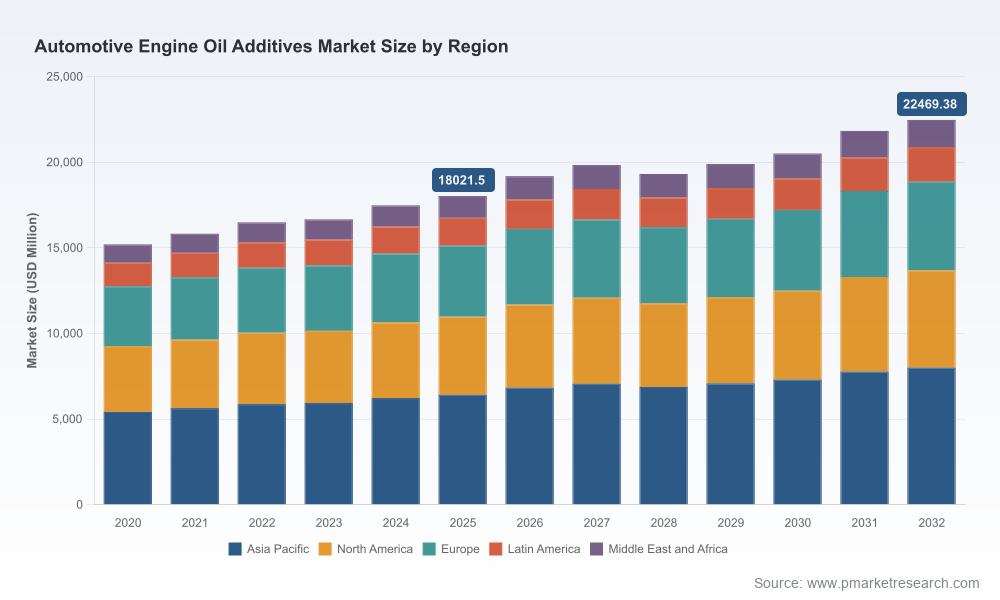
The worldwide automotive engine oil additives market has reached a mature scale, with total revenue expanding from approximately $15.2 billion in 2020 to an estimated $18.0 billion in 2025. Looking ahead, the sector is projected to grow at a compound annual growth rate of 3.21%, reaching roughly $22.5 billion by 2032. At first glance, a low-to-mid single-digit growth trajectory suggests a steady, unremarkable market. A closer examination reveals a landscape defined by platform transitions, regulatory acceleration, and shifting cost dynamics that are quietly reshaping competitive advantage.
PW Consulting
The market is no longer driven primarily by volume expansion tied to global vehicle parc growth. Instead, value creation is increasingly concentrated in formulation sophistication, compliance readiness, and the ability to deliver performance across increasingly diverse engine architectures. Regional demand patterns reflect mature automotive markets in the West alongside rapid fleet modernization in Asia-Pacific, while vehicle-type segmentation underscores the enduring importance of passenger cars alongside sustained commercial fleet activity. No single region or application dominates the narrative; rather, the interplay between regulatory timelines, OEM approval cycles, and formulation complexity is setting the pace.
Three structural challenges define the current inflection point:
- Regulatory fragmentation and transition friction. The industry is navigating overlapping specifications, backward compatibility requirements, and staggered implementation deadlines. Formulators must manage dual inventories, re-validate supplier packages, and absorb testing costs while OEMs phase in next-generation engines.
- Cost volatility in base oils and additive components. Early 2026 saw multiple suppliers announce price increases of up to 15-20% on finished lubricants and core components, driven by geopolitical tensions in the Middle East and persistent supply chain pressures. Margin resilience now depends on blend optimization, inventory strategy, and long-term contract flexibility.
- Performance parity across viscosity grades and engine architectures. Modern engine designs, including downsizing, turbocharging, and hybridization, require additive packages that balance fuel economy, wear protection, soot handling, and deposit control. Achieving this balance without compromising compatibility or total cost of ownership is a persistent engineering and commercial challenge.
Key Drivers Reshaping the Market
Technology Innovation and Specification Evolution
The introduction of the ILSAC GF-7 specification, first licensed in March 2025, marks a meaningful step change in passenger car oil requirements. The updated standard emphasizes enhanced fuel efficiency, reduced low-speed pre-ignition risk, and improved piston cleanliness for model year 2026 vehicles. Alongside it, the API SQ category addresses ultra-low viscosity grades that fell outside GF-7 coverage, with both standards designed to remain backward compatible to prior GF-6 and API SP formulations. This dual-track environment is accelerating demand for advanced additive packages capable of delivering performance across a broader viscosity and shear profile.
Leading additive developers have already responded with targeted technology launches. In mid-2025, The Lubrizol Corporation introduced passenger car engine oil additive technology PV1710 to enable oil marketers to meet ILSAC GF-7 performance requirements. Meanwhile, Evonik Oil Additives showcased innovative lubricant additive solutions at the 79th STLE Annual Meeting & Exhibition, reinforcing the industry’s focus on next-generation formulation architectures. These moves are not merely product updates; they signal a broader shift toward specification-led innovation, where compliance readiness becomes a commercial moat.
Regulatory Pressure and Emissions-Driven Formulation Constraints
Stricter global emissions regulations in the United States, European Union, China, and India continue to mandate lower SAPS engine oils, compressing the formulation space and increasing reliance on specialized additive chemistry. Sulphated ash, phosphorus, and sulfur limits are no longer optional design parameters; they are binding constraints that influence wear protection, oxidation stability, and deposit control. As a result, additive suppliers are under pressure to deliver high-performance solutions that operate within tighter chemical boundaries while maintaining engine durability and oil drain intervals.
The regulatory trajectory is not uniform across regions, which creates both complexity and opportunity. Formulators serving multi-market portfolios must manage divergent SAPS targets, testing protocols, and OEM approval requirements. Companies that can modularize additive packages, streamline qualification workflows, and provide region-specific performance validation are gaining a structural advantage in tenders and OEM partnerships.
Demand-Side Shifts in Vehicle Architecture and Service Behavior
Passenger cars remain the largest vehicle-type segment, but the underlying demand profile is changing. Downsized turbocharged engines, increased use of stop-start systems, and the gradual integration of hybrid architectures are altering oil temperature cycles, shear exposure, and contamination patterns. These changes place new demands on dispersancy, viscosity control, and anti-wear performance. At the same time, extended drain intervals and consumer expectations for reduced maintenance frequency are pushing formulators to balance performance longevity with cost structure.
Commercial fleets continue to exert steady demand, particularly where heavy-duty and light commercial vehicles operate under high-load, high-temperature conditions. In these applications, oxidation inhibition, soot management, and corrosion control remain critical. The commercial side of the market is less sensitive to consumer branding and more responsive to total cost of ownership, fleet uptime, and warranty exposure, making reliability and specification compliance central purchasing criteria.
Supply Chain and Cost Structure Realignment
The additive value chain is experiencing renewed cost pressure. Base oil and additive input costs rose in early 2026, with multiple suppliers announcing price increases on finished lubricants and core components. Rather than treating this as a transient fluctuation, market participants are re-evaluating blend economics, inventory buffers, and supplier diversification. Formulators are increasingly prioritizing packages that offer performance density—delivering required protection and efficiency with optimized loadings—to absorb input cost increases without eroding end-product competitiveness.
This environment also rewards transparency and partnership. Oil marketers and OEMs are seeking additive suppliers who can provide clearer cost drivers, alternative chemistry pathways, and scenario-based blending guidance. The ability to collaborate on formulation trade-offs is becoming a differentiator in a market where price alone is insufficient to secure long-term supply relationships.
Competitive Landscape: Positioning, Differentiation, and Evolution
The market remains moderately concentrated, with a handful of global specialty additive providers commanding a significant share of high-performance package supply. This concentration reflects the technical barriers to entry, the cost of OEM approvals, and the scale required to sustain multi-region qualification programs. At the same time, regional producers—particularly in China and India—are expanding capacity and offerings, creating a more layered competitive field where global incumbents and local specialists coexist.
Several strategic positioning patterns are evident among the leading companies:
Rubber Additives Market
- Specification-first technology roadmaps. Companies such as The Lubrizol Corporation and Infineum International Limited are aligning development pipelines closely with upcoming standards, including ILSAC GF-7 and API SQ compliance. Their differentiation lies in packaging additive technologies—viscosity modifiers, dispersants, anti-wear components, and LSPI-mitigation chemistry—into ready-to-qualify solutions that reduce time-to-market for oil marketers.
- Portfolio breadth and OEM approval depth. Chevron Oronite Company LLC, BASF SE, and Evonik Industries AG leverage extensive portfolios spanning antioxidants, dispersants, viscosity index improvers, and specialized performance additives. Their scale enables multi-market qualification support and the flexibility to tailor packages across passenger car, heavy-duty, and driveline applications.
- Regional manufacturing and cost-competitive packages. Chinese and Indian producers, including Jinzhou Kangtai Lubricant Additives, Wuxi South Petroleum Additive, Tianhe Chemicals Group, and Dorf Ketal Chemicals India, are building presence through detergent-dispersant packages, antioxidants, and corrosion inhibitors. Their growth is tied to regional fleet expansion, cost positioning, and increasing integration into global supply chains where specification alignment is improving.
- Specialty and sustainability-oriented chemistry. Croda International Plc and BRB International B.V. highlight niche differentiation through friction modifiers, bio-based components, and viscosity modifiers tied to group-level supply relationships. These players illustrate how targeted chemistry and supply chain adjacency can create defensible positions even in a concentrated market.
The competitive evolution is neither a simple consolidation story nor a pure fragmentation narrative. Instead, it is a layering effect: global leaders deepen specification alignment and OEM relationships, regional manufacturers scale capacity and improve formulation parity, and niche players focus on specific performance attributes or sustainability angles. Mergers and partnerships are likely to continue where they unlock qualification speed, regional reach, or chemistry complementarity. New entry remains challenging without a clear pathway to approvals and volume scale, but targeted acquisitions of formulation capability or regional production assets can accelerate positioning.
A practical implication for oil marketers and OEMs is that supplier selection is increasingly a function of compliance readiness, technical collaboration, and supply resilience—not just price per kilogram. Companies that can provide validated packages, transparent cost logic, and flexible blending options are better positioned to navigate specification transitions and cost volatility simultaneously.
Future Trends and Commercial Opportunities for the Next 3–5 Years
Trend 1: Specification-Led Reformulation as a Recurring Revenue Driver
The market is moving toward a regime where periodic specification upgrades—not just vehicle parc growth—drive meaningful reformulation activity. With ILSAC GF-7 and API SQ now in motion, and with regional emissions regimes continuing to tighten, additive packages will need periodic refreshes to maintain compliance and performance. For additive suppliers, this creates recurring engagement with oil marketers and OEMs, longer qualification cycles, and opportunities to lock in multi-year supply agreements tied to specification roadmaps. For oil marketers, the commercial opportunity lies in sequencing product launches to match OEM introduction timelines, minimizing inventory friction while capturing performance premium where permitted.
Trend 2: Performance Density and Low-SAPS Innovation as Margin Defenders
As input costs remain volatile and regulatory constraints tighten, formulation efficiency becomes a strategic lever. Additive packages that deliver required protection, fuel economy, and cleanliness at optimized loadings will be valued for their ability to protect margins without sacrificing performance. Innovation in dispersancy under low-SAPS conditions, viscosity control across shear profiles, and anti-wear chemistry compatible with tighter chemical limits will differentiate suppliers. Companies that can demonstrate measurable performance-per-unit-chemistry will have stronger footing in price negotiations and portfolio planning.
Trend 3: Regional Alignment and Multi-Source Supply as Risk Mitigation
Geopolitical disruptions and cost spikes are pushing the industry toward more resilient sourcing models. Multi-source strategies, regional production footprints, and scenario-based inventory planning are becoming standard expectations rather than optional safeguards. This trend benefits suppliers with diversified manufacturing locations and clear continuity plans, while also encouraging oil marketers to qualify backup packages where feasible. The commercial opportunity is in designing supply architectures that can absorb regional shocks without compromising specification compliance or lead-time reliability.
Potential risks and uncertainties should be factored into planning. Regulation timing can shift, as seen with the extended overlap period for ILSAC GF-6 and ILSAC GF-7 through October 2026, which affects product transition pacing and inventory decisions. Raw material cost trajectories may continue to fluctuate with geopolitical and logistics dynamics. In parallel, the long-term mix shift toward hybridization and electrification could gradually alter additive demand patterns in certain segments, even as internal combustion engines remain significant for the foreseeable future. Market participants should therefore treat flexibility, scenario planning, and qualification readiness as core capabilities rather than reactive measures.
Fuel Additives Market
Actionable Guidance for Decision-Makers
For Additive and Oil Manufacturers
Align development pipelines directly with specification calendars and OEM introduction timelines. Treat compliance readiness as a commercial asset, and invest in modular package design that can be adapted across viscosity grades and regional SAPS targets. Where input cost pressure is persistent, prioritize performance density and blending efficiency to protect margins without compromising qualification outcomes. Strengthen technical collaboration with oil marketers and OEMs to co-optimize formulations for real-world duty cycles, which can reduce rework and accelerate approvals.
For Investors and Corporate Strategists
Focus on companies with demonstrated specification alignment, OEM approval depth, and supply chain resilience. Evaluate exposure to recurring reformulation cycles, regional cost structures, and the ability to monetize performance differentiation in a competitive pricing environment. Monitor how regional producers scale quality and compliance capabilities, as this will shape bargaining dynamics and market access over the next several years. In due diligence, give weight to qualification pipelines and multi-region readiness, since these often determine whether growth translates into durable share gains.
For Procurement and Supply Chain Leaders
Build procurement strategies around supply continuity and formulation flexibility rather than spot-price optimization alone. Qualify alternative packages where specifications permit, and negotiate contracts that provide visibility into cost drivers and escalation mechanisms. Use scenario planning to manage inventory during specification transitions, and prioritize suppliers who can provide clear technical support for blend adjustments and duty-cycle-specific performance. Where possible, establish partnerships that allow faster response to raw material volatility without sacrificing compliance or lead times.
Closing Perspective
The automotive engine oil additives market is entering a phase where steady headline growth masks a more dynamic underlying competition. Specification upgrades, emissions-driven formulation constraints, and input cost volatility are reshaping how value is created and captured. Companies that treat compliance readiness, performance density, and supply resilience as strategic pillars are better positioned to convert regulatory and technical change into durable commercial advantage. For decision-makers seeking granular segmentation data, competitive benchmarks, and tailored scenario planning, a deeper dive into the full market study can provide the detailed breakdown needed to translate these trends into actionable strategy.
For detailed analysis of this topic, please visit the official page: Worldwide Automotive Engine Oil Additives Market
Lacy Lee
Senior Marketing Manager
sales@pmarketresearch.com
00852-95632430
PW Consulting: www.pmarketresearch.com
More Posts


Report This Post
Please complete the following requested information to flag this post and report abuse, or offensive content. Your report will be reviewed within 24 hours. We will take appropriate action as described in Findit terms of use.
