


Right Now

Strategic Horizons: Navigating the Managed Security Services System Market
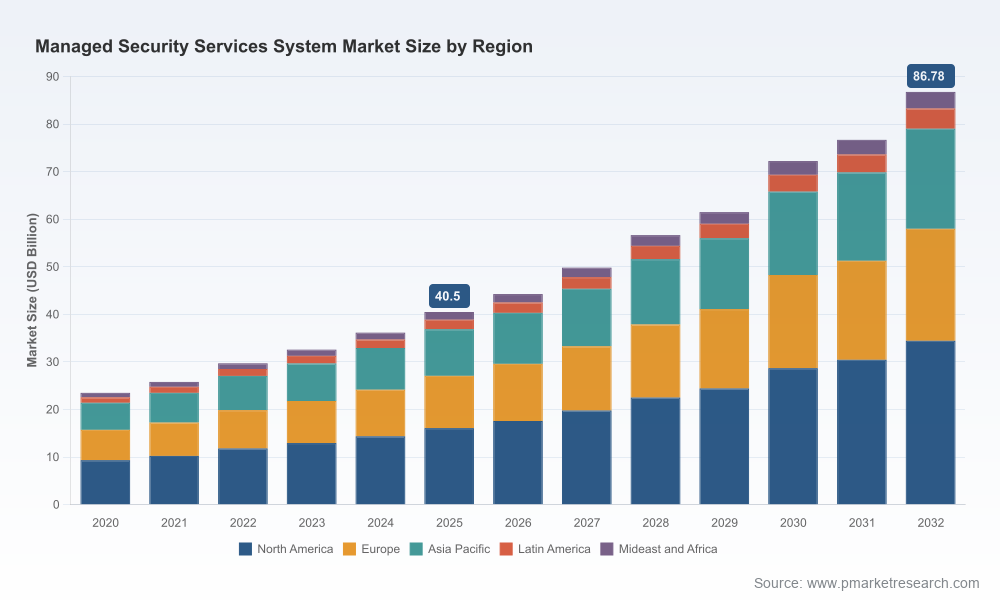
The managed security services sector has transitioned from a peripheral IT function to a core business enabler. As organizations grapple with expanding threat surfaces and a persistent shortage of internal security expertise, the outsourcing of security operations has become a strategic imperative rather than a cost-cutting exercise. Market valuations reflect this structural shift, with the sector moving from approximately $23.5 billion in 2020 to an estimated $40.5 billion in 2025. The forward trajectory indicates sustained momentum, with projections pointing toward $86.78 billion by 2032. This expansion is underpinned by a compound annual growth rate of 11.5 percent across the 2026-2032 forecast window, signaling that demand will outpace general IT spending growth for the foreseeable future.
Such growth is not uniform across all segments or geographies. The market structure reveals a moderately fragmented landscape, with the top three providers accounting for roughly 22.4 percent of total revenue and the top five capturing 34.1 percent. This concentration level suggests that while scale players dominate headline contracts, significant room remains for specialized providers, regional specialists, and niche service models to capture value. The organization size split further illustrates the breadth of adoption, with large enterprises representing the larger revenue share while small and medium-sized enterprises contribute a substantial portion of the market, driven by their growing reliance on external security operations centers to compensate for limited internal headcount. The regional distribution shows North America maintaining a leading position, followed by Europe and Asia Pacific, with Latin America and the Middle East and Africa representing faster-growing-but-smaller bases that are increasingly attractive for providers seeking diversification.
The market is currently navigating three critical inflection points that will define competitive outcomes over the next several years. First, the convergence of traditional managed security services with extended detection and response capabilities is blurring the line between monitoring and active threat hunting. Buyers increasingly expect providers to deliver contextual response, not just alert generation. Second, the rapid deployment of artificial intelligence and automation within security operations is creating a dual dynamic: providers can scale service delivery more efficiently, but clients are also demanding greater transparency into how AI-driven decisions are made and validated. Third, regulatory fragmentation is intensifying operational complexity. Data sovereignty requirements, cross-border data flow restrictions, and sector-specific compliance mandates are forcing providers to localize service delivery models, adjust data handling practices, and invest in compliance evidence generation. These pressures are reshaping both pricing structures and service design.
Key Drivers Reshaping Demand and Supply
Technology innovation remains the most visible catalyst. The shift from signature-based monitoring to behavior analytics, identity-centric controls, and integrated threat intelligence has raised the baseline expectation for what managed services must deliver. Providers are embedding automation into triage, investigation, and initial response workflows, enabling faster mean time to respond while reducing the operational burden on client teams. This technological evolution is not merely an efficiency play; it is redefining service boundaries. Offerings that once focused on firewall management or intrusion detection are now expanding into vulnerability lifecycle coordination, compliance evidence generation, and proactive threat hunting. The result is a blurring of categories that favors providers capable of orchestrating multiple security functions under a unified operating model.
Regulatory and policy dynamics are equally influential. In the United States, more than 300 data center-related bills were introduced across thirty states in early 2026, addressing energy costs, grid reliability, and special tariffs for large energy users. These developments matter for managed security services because the underlying infrastructure that supports security monitoring, log retention, and analytics is increasingly tied to data center capacity and power availability. Concurrently, the White House Ratepayer Protection Pledge requires hyperscalers and AI or data center operators to cover the full costs of energy generation and infrastructure to avoid passing expenses to households. While this policy targets energy economics directly, it indirectly shapes the cost structure and geographic placement of the infrastructure that managed security providers rely upon. On the data governance front, the US Department of Justice Bulk Data Rule, effective from 2025, mandates stringent cybersecurity controls for certain bulk personal data transactions involving foreign parties. This rule raises the compliance bar for providers handling sensitive datasets across borders and reinforces the importance of contractual clarity, control mapping, and audit readiness.
Demand-side behavior is evolving as well. Organizations are increasingly treating security operations as a continuous capability rather than a periodic audit exercise. The shortage of skilled analysts, combined with the expansion of hybrid cloud environments, has made it difficult for many enterprises to sustain 24/7 internal coverage. This gap has accelerated adoption among large enterprises seeking to augment existing teams and among smaller organizations that need enterprise-grade monitoring without building a full security operations center from scratch. At the same time, buyers are becoming more sophisticated in their evaluation criteria. They are comparing providers not only on cost but on response quality, threat intelligence relevance, integration with existing tooling, and the ability to deliver measurable risk reduction. This shift rewards providers that can articulate operational outcomes rather than simply list service features.
Supply-side and cost dynamics are also in flux. The cost of delivering managed security services is influenced by labor availability, infrastructure pricing, and the efficiency of automation. As energy and data center constraints become more pronounced in certain regions, providers may face pressure on facility costs and service placement decisions. At the same time, automation and platform consolidation are helping offset labor constraints, enabling providers to serve more clients with comparable teams. The net effect is a market where differentiation is increasingly tied to operational efficiency, service quality, and the ability to localize delivery without sacrificing scale economies.
Competitive Landscape and Strategic Positioning
The competitive field includes a mix of established security vendors, telecommunications-adjacent providers, and pure-play managed security service specialists. IBM Security leverages its broad enterprise footprint and hybrid cloud security capabilities to offer continuous monitoring, management, and response across complex environments. Its positioning emphasizes integrated services that align with broader digital transformation initiatives, appealing to organizations that prefer a single provider for security operations and infrastructure Advisory. Verizon draws on its global network infrastructure to deliver threat detection, mitigation, and incident response, with particular strength in services that benefit from network-level visibility such as DDoS mitigation and secure access architectures. Its value proposition centers on the combination of connectivity scale and security operations, which can be attractive for organizations seeking integrated network and security service delivery.
Pure-play providers have carved out distinct positions by focusing deeply on managed detection and response and adjacent services. LevelBlue, formed from the combination of AT&T Cybersecurity and Trustwave, delivers 24/7 managed detection and response, managed security, offensive security, and FedRAMP authorized services. Its recognition as a representative vendor in the 2026 Gartner Market Guide for Outsourced Managed Security Services underscores its relevance in the outsourcing segment. Secureworks emphasizes managed threat detection and response built around its XDR platform, positioning itself around platform-enabled service delivery and threat intelligence integration. Arctic Wolf and eSentire both focus on concierge-style, expert-led security operations with continuous detection and response across endpoints, networks, and cloud environments, targeting organizations that want hands-on guidance alongside monitoring. Tata Communications brings a global network-integrated perspective, emphasizing security monitoring and threat management that align with broader connectivity and cloud services.
Recent developments illustrate how providers are moving to capture emerging opportunities. In April 2026, NWN launched an AI-enabled managed security operations suite spanning managed detection and response, offensive security services, ransomware protection, and virtual chief information security officer services, supported by new platform integrations. This move reflects a broader push to bundle response capabilities with advisory and proactive security functions. Also in April 2026, Beyond was named the 2026 Google Cloud Security Managed Security Service Provider for EMEA for Agentic SOC capabilities, highlighting the growing importance of cloud-native security operations and AI-assisted SOC models in regional markets. In March 2026, Palo Alto Networks introduced Next-Generation Trust Security with certificate lifecycle automation to support managed security resilience, signaling attention to identity and trust foundations that underpin secure service delivery. These announcements point to a market where providers are expanding service breadth, integrating automation more deeply, and aligning with cloud and trust architectures.
The market structure is evolving along multiple axes. Consolidation is likely to continue among providers seeking scale, broader geographic reach, or complementary capabilities such as offensive security, compliance management, and advisory services. At the same time, differentiation will remain vital in segments where buyers prioritize specialization, industry-specific expertise, or regional data handling requirements. New entrants and cloud-aligned partners are also shaping the landscape by offering managed security services that are tightly integrated with specific cloud platforms or by emphasizing agentic SOC capabilities that combine automation with expert oversight. The net effect is a market where scale, specialization, and platform integration are all viable paths, but sustained advantage will depend on execution quality, response effectiveness, and the ability to adapt to regulatory and infrastructure constraints.
Future Trends and Commercial Opportunities
One of the most consequential trends for the next three to five years is the maturation of AI-assisted security operations combined with human-led judgment. Automation will increasingly handle triage, enrichment, and initial containment, but buyers will expect providers to demonstrate control over false positive management, decision traceability, and escalation quality. The commercial opportunity lies in service models that clearly delineate what is automated, what is expert-reviewed, and how outcomes are measured. Providers that can show consistent reduction in dwell time, improved containment rates, and transparent operational metrics will be better positioned to command premium pricing and deeper client relationships.
Manned Security Services Market
A second trend is the growing importance of trust infrastructure and compliance-as-operational-service. As certificate lifecycle automation, identity controls, and data handling requirements become more central to security resilience, managed security providers are likely to expand into assurance services that help clients maintain continuous compliance evidence, manage third-party risk, and align security operations with emerging regulatory expectations. This creates opportunities for providers to integrate compliance workflows into day-to-day monitoring rather than treating compliance as a separate engagement. The upside is stronger client stickiness and clearer value demonstration, but the challenge is maintaining accuracy and auditability at scale.
A third trend is the geographic and infrastructure realignment of service delivery. Energy constraints, data center policy shifts, and data sovereignty pressures will influence where processing occurs, how logs are retained, and which providers can serve certain regions without friction. This realignment favors providers that can operate flexible delivery models, maintain compliance with local requirements, and manage infrastructure dependencies efficiently. For commercial strategy, this means that regionalization is not merely a sales tactic but an operational capability that can determine win rates in regulated or infrastructure-constrained markets. Organizations that build or partner for localized delivery will be better positioned to capture growth in Europe, Asia Pacific, and emerging markets, while also navigating US policy dynamics that affect infrastructure economics.
These trends carry potential risks. Over-reliance on automation without adequate oversight can degrade service quality and erode client trust. Regulatory fragmentation may increase operational costs and complicate cross-border service models. Infrastructure constraints could pressure margins if providers cannot optimize placement or pass through cost changes transparently. Finally, market growth may attract additional competition, compressing pricing in commoditizing segments while rewarding providers that differentiate through outcomes, expertise, and integrated service design.
PW Consulting Information & Electronics Research Center
Implications and Actionable Guidance for Decision Makers
For organizations procuring managed security services, the priority is to align service selection with operational reality rather than catalog breadth. Evaluate providers based on response quality, integration with existing tools, clarity around automation use, and the ability to deliver measurable risk reduction. Define success metrics upfront, including detection coverage, response timelines, escalation pathways, and compliance evidence generation. Ensure contractual terms address data handling, localization requirements, and performance transparency so that service delivery matches regulatory and operational expectations.
Smart Home Security System Market
For providers and technology manufacturers, the strategic focus should be on orchestration and outcomeDemonstration. The market is rewarding providers that can integrate multiple security functions, automate routine workflows without losing expert oversight, and present clear evidence of operational impact. Investment in platform integration, analyst enablement, and compliance-aligned service design can create defensible differentiation. At the same time, monitoring infrastructure and energy policy developments will be important for managing cost structures and placement decisions, particularly in regions where data center constraints are becoming more salient.
For investors and strategic planners, the market offers growth but demands disciplined segmentation. The headline expansion masks variation across service types, organization sizes, and regions. Value creation will increasingly concentrate among providers that can combine scale with specialization, demonstrate measurable security outcomes, and adapt to regulatory and infrastructure shifts. Due diligence should assess not only revenue trajectory but also service quality, retention dynamics, automation maturity, and the provider’s ability to operate across evolving compliance and data sovereignty requirements.
The managed security services system market is expanding in both scale and complexity. Buyers are demanding more than monitoring; providers are racing to integrate automation, response, and trust infrastructure into cohesive service models; and regulatory and infrastructure dynamics are reshaping where and how services can be delivered. In this environment, timely access to detailed segmentation data, competitive tracking, and scenario-based planning can make the difference between reactive participation and deliberate strategy. For decision makers seeking deeper insight into service-type breakdowns, regional dynamics, competitive movements, and customized strategic recommendations, the full PW Consulting market report provides the granular detail and structured analysis needed to support confident planning.
For detailed analysis of this topic, please visit the official page: Managed Security Services System Market
Lacy Lee
Senior Marketing Manager
sales@pmarketresearch.com
00852-95632430
PW Consulting: www.pmarketresearch.com
More Posts


Report This Post
Please complete the following requested information to flag this post and report abuse, or offensive content. Your report will be reviewed within 24 hours. We will take appropriate action as described in Findit terms of use.
