


Right Now

Strategic Trends and Commercial Opportunities in the Global Percutaneous Nephroscope Market
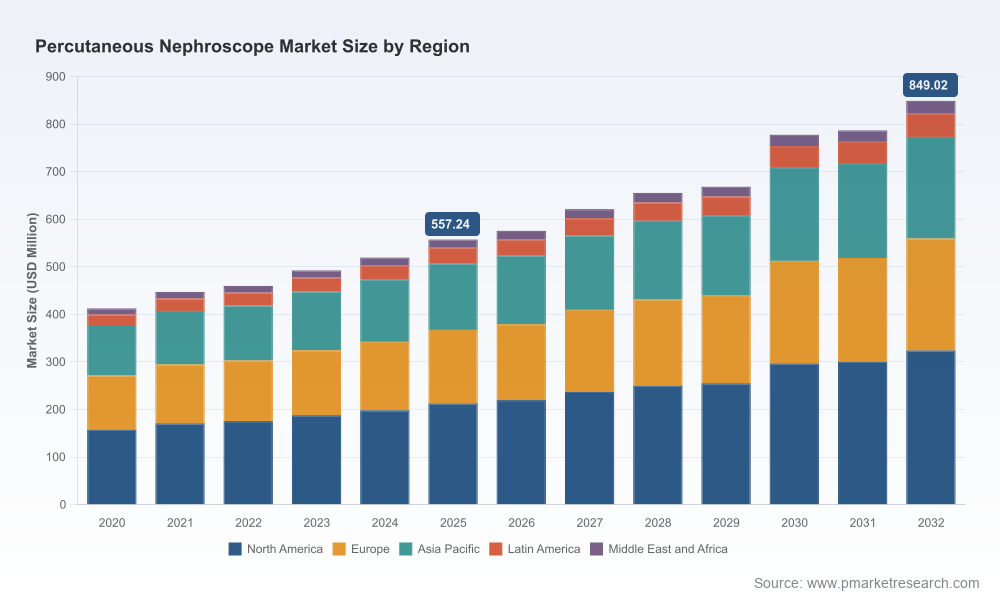
The global market for percutaneous nephroscopes has entered a phase of steady, structurally driven expansion, valued at approximately USD 557.24 million in 2025. Over the historical window from 2020 to 2025, the sector demonstrated consistent year-over-year growth, reflecting the broader shift toward minimally invasive urological interventions and the gradual replacement of older endoscopic approaches. Looking ahead through 2032, the market is projected to reach USD 849.02 million, translating to a compound annual growth rate of 6.19 percent. This trajectory is not explosive, but it is remarkably resilient, anchored in clinical necessity, device longevity, and the ongoing rationalization of procedural pathways in kidney stone management.
For decision-makers evaluating this space, the headline figures tell only part of the story. The real strategic signal lies in the composition of that growth. The market is split between rigid and flexible instrument architectures, with rigid designs capturing the larger share of revenue. Hospitals remain the dominant application setting, while ambulatory surgical centers represent a meaningful and steadily growing secondary channel. Geographically, mature markets in North America and Europe continue to drive the largest absolute volumes, but the Asia Pacific region has emerged as a critical growth engine, alongside gradually expanding activity across Latin America and the Middle East and Africa. Concentration metrics indicate that the top three players account for roughly 58.4 percent of total market value, and the top five extend that share to 72.15 percent, underscoring an environment where scale, regulatory readiness, and channel control remain powerful differentiators.
Key Challenges and Inflection Points
Despite the favorable growth outlook, the percutaneous nephroscope market is navigating several interconnected pressures that will shape competitive outcomes over the next five years. The first challenge is the tension between clinical performance expectations and operational cost constraints. Urologists increasingly demand instruments that combine excellent optical clarity, reliable irrigation, and smooth maneuverability, yet hospital procurement teams are under continuous pressure to standardize formularies, reduce per-procedure device cost, and improve tray utilization. This creates a negotiation environment where premium features must be justified not only by clinical outcomes but also by workflow efficiency, reprocessing turnaround, and durability across multiple cycles.
A second inflection point is regulatory divergence across regions. In the United States, percutaneous nephroscopes are classified as Class II devices requiring 510(k) clearance under FDA 21 CFR 876.1500, which creates a relatively predictable but still demanding pathway for product variations and design updates. In Europe, the Medical Device Regulation landscape requires Notified Body certification for devices sold in the region, adding a layer of conformity assessment that influences product launch timing, portfolio breadth, and post-market documentation burden. Manufacturers operating across both markets must manage parallel compliance strategies, which can widen the competitive gap between companies with mature regulatory infrastructure and those relying on patchwork submissions.
A third challenge lies in reprocessing and sterilization discipline. Reusable nephroscopes must withstand steam sterilization at 132–134°C for three to four minutes under AAMI ST79 guidelines, a requirement that places material integrity and channel design under continuous operational stress. Any weakness in sheath durability, optical bundle resilience, or reprocessing compatibility can affect utilization economics and hospital acceptance. As a result, instrument lifespan and sterilization robustness have become strategic attributes rather than purely engineering details, especially for high-volume centers where tray turnover directly influences procedural throughput.
Key Demand Drivers Reshaping the Market
Technology Innovation and Optical Performance
The most visible driver of commercial activity is the ongoing refinement of optical systems and instrument ergonomics. Recent product activity shows a clear pattern: manufacturers are not merely expanding catalog size, they are improving image compatibility, refining working-channel performance, and tailoring sizes to specific procedural needs. In March 2024, Karl Storz showcased updated IMAGE1 S™-compatible percutaneous nephroscopes at the EAU 2024 Congress, signaling a continued push toward platforms that integrate with advanced imaging ecosystems rather than functioning as standalone rigid instruments. A few months earlier, in November 2023, Olympus added new 22 Fr percutaneous nephroscope variants to its global urology catalog with enhanced optics, illustrating the broader emphasis on size options and visual performance. Meanwhile, Richard Wolf received updated EU MDR certification for its percutaneous nephroscope lineup in September 2023, reinforcing the importance of regulatory alignment as a precondition for sustained market access in Europe.
These developments matter because they connect directly to procedural confidence. Better optics, stable irrigation, and smoother insertion profiles reduce friction in percutaneous nephrolithotomy workflows, which in turn influences adoption decisions in both high-volume hospital programs and outpatient surgical settings. For manufacturers, the strategic implication is that incremental product improvement must be paired with platform thinking: instruments that can interface cleanly with existing visualization and accessory ecosystems are more likely to earn long-term formulary positions than isolated device introductions.
Reimbursement and Procurement Economics
Economic incentives remain a powerful structural driver. Under the CMS Physician Fee Schedule in January 2025, CPT code 50081 reimburses percutaneous nephrostolithotomy procedures involving nephroscope use at an average Medicare facility fee of $4,200. While reimbursement rates vary by region, payer mix, and setting, this baseline illustrates that procedural economics continue to support the use of nephroscopic interventions in appropriate patient populations. More importantly, reimbursement visibility influences capital planning and device selection. When procedures are financially viable, hospitals and surgical centers are more willing to standardize around reliable instrument platforms, invest in accessory ecosystems, and maintain trained urology teams.
From a procurement standpoint, the economic conversation is shifting from unit price alone to total cost of ownership. Reusable instruments, reprocessing labor, repair frequency, and tray configuration all feed into hospital budgeting models. Companies that can demonstrate predictable instrument longevity, lower failure rates, and efficient sterilization compatibility are better positioned to defend premium positioning or expand share of wallet within an institution.
Demand-Side Shifts in Urological Practice
On the demand side, the trend toward earlier and more targeted intervention for kidney stone disease continues to support nephroscope utilization. Clinical preferences increasingly favor approaches that can manage stones efficiently while minimizing trauma and recovery burden. That dynamic benefits instruments that combine access reliability with procedural flexibility. At the same time, ambulatory surgical centers are gaining relevance as an application channel, reflecting broader shifts in procedure migration, capacity management, and patient throughput. As more cases move into settings where operating room time is tightly managed, instrument turnaround, setup simplicity, and compatibility with standardized trays become more important than in traditional inpatient environments.
Supply Chain and Cost Structure Pressures
Supply chain considerations also shape market behavior. Percutaneous nephroscopes rely on medical-grade materials and precision assembly, with sheaths commonly constructed from materials such as medical-grade 316L stainless steel and imaging supported by fiber-optic bundles in line with ISO 7153-1 standards. These material and design requirements create a baseline cost structure that is not easily undercut by low-quality substitutes without sacrificing performance or compliance. At the same time, global supply dynamics—raw material availability, manufacturing consistency, and logistics reliability—contribute to product planning cycles and inventory strategy. Firms with controlled manufacturing footprints and disciplined quality systems are better able to maintain steady availability, which is an underappreciated advantage in a market where procedural schedules depend on instrument readiness.
Worldwide Nephrology Stents And Catheters Market
Competitive Landscape and Leading Strategies
The competitive environment is concentrated but not static. Karl Storz, headquartered in Tuttlingen, Germany, remains a leading provider of rigid percutaneous nephroscopes, with models such as NAGELE and PARRECA optimized for PCNL procedures and integrated camera systems. Its positioning emphasizes compatibility with advanced imaging platforms and a strong presence in professional congress settings, which helps reinforce clinical visibility and adoption momentum. Olympus, based in Tokyo, Japan, offers OES Pro percutaneous nephroscopes in multiple sizes, including 24 Fr configurations designed for kidney stone fragmentation and extraction. Olympus’s strategy appears centered on breadth within the urology portfolio and incremental size and optics enhancements that support a wide procedural range.
Richard Wolf, also headquartered in Knittlingen, Germany, specializes in urological endoscopes and offers percutaneous nephroscopes such as the 26 Fr model with continuous irrigation for PCNL applications. Its emphasis on irrigation performance and regulatory certification underscores a practical, procedure-focused approach. Pentax Medical, part of the HOYA Group and based in Tokyo, provides rigid nephroscopes such as the VNL-24N2 model designed for percutaneous access and stone management, contributing to the pool of established rigid-instrument options. Cook Medical, based in Bloomington, Indiana, takes a somewhat different angle by supplying percutaneous nephroscopy kits that include access sheaths compatible with standard nephroscopes for urological interventions. This kit-based approach broadens the commercial opportunity beyond the scope itself and into the surrounding procedural ecosystem.
Strategic Positioning and Differentiation
Across these players, differentiation is emerging along several axes. One is imaging and platform integration. Companies that align their instruments with next-generation visualization technologies are better positioned to capture attention at clinical forums and in procurement discussions where image quality and compatibility are weighted heavily. Another is procedural reliability through design details such as irrigation continuity, sheath performance, and instrument balance, all of which influence user confidence during demanding stone-management cases. A third axis is regulatory and market-access readiness. Certification status, international conformity, and documentation rigor increasingly act as gatekeepers for sustained European and multi-regional sales, especially for organizations seeking to scale across diverse healthcare systems.
A fourth differentiator is commercial breadth. Manufacturers that pair scopes with compatible accessories, access sheaths, and procedure kits create more complete solutions for hospitals and surgical centers. In practice, this can strengthen loyalty by reducing sourcing complexity and improving tray standardization. It also provides a buffer against pure price competition, because value is created not only by the scope but by the consistency of the entire intervention setup.
Market Evolution: Consolidation, Fragmentation, and New Entrants
The market’s concentration structure suggests room for continued strategic consolidation among established players, particularly where scale in regulatory affairs, manufacturing, and global distribution provides durable advantages. At the same time, niche differentiation remains viable. Smaller or more focused entrants can compete by targeting specific size requirements, specialized imaging compatibility, or regional relationship-driven channels. The more likely evolution is not a single dominant shakeout, but a layered competitive field in which leading multinationals defend core share, mid-tier specialists compete on performance or channel strength, and new entrants test narrow gaps in ergonomics, compatibility, or service model. Companies that rely solely on commodity positioning will face the greatest pressure, because price alone is unlikely to overcome the clinical and operational demands of high-volume urology programs.
Future Trends and Commercial Implications
Platform-Based Procurement and Ecosystem Lock-In
Over the next three to five years, one likely trend is the acceleration of platform-oriented procurement. As hospitals and surgical centers work to reduce variability, they will increasingly favor instrument families that integrate cleanly with visualization systems, accessory sets, and reprocessing workflows. The commercial opportunity here lies in designing scope lines that can serve as anchor products within broader urology portfolios. Manufacturers that build recognizable, compatible ecosystems can improve retention, increase basket size, and reduce the likelihood of fragmented purchasing across multiple vendors. The risk is that platform strategy requires sustained investment and careful compatibility planning; missing a key integration point can weaken adoption even when the core instrument is strong.
PW Consulting
Regional Growth Divergence and Access Strategy
A second trend is continued regional divergence in growth pace and procurement style. While mature markets will likely remain volume anchors, growth momentum is expected to be strongest in regions where surgical capacity is expanding, urological services are becoming more accessible, and cost-conscious procurement is balanced by a desire for reliable outcomes. The strategic implication is that uniform global launches are less effective than tailored access strategies. In some markets, winning may depend on regulatory readiness and distributor relationships; in others, it may depend on demonstration of cost efficiency and instrument durability; in still others, clinical education and procedural training may be the dominant lever. Firms that treat regional strategy as a single playbook will leave growth on the table.
Setting Expansion and Ambulatory Channel Growth
The third trend is the gradual expansion of procedural activity into ambulatory surgical centers and other outpatient environments where throughput, turnover, and standardization are paramount. This shift creates opportunities for instruments and kits that are easy to set up, easy to sterilize, and easy to manage within constrained operational windows. For suppliers, this means that usability and reprocessing compatibility may become as commercially important as raw optical performance. The risk side of this trend is that outpatient settings can be more sensitive to device cost and inventory complexity, so product introductions must be aligned with real-world tray economics rather than engineered only for idealized use.
Actionable Recommendations for Decision-Makers
For manufacturers, the priority should be to align product roadmaps with platform compatibility, reprocessing durability, and regional regulatory readiness. Roadmaps that treat nephroscopes as isolated instruments risk underusing the commercial leverage available through imaging integration, accessory pairing, and tray-level standardization. At the same time, companies should prioritize clear value communication around instrument longevity and sterilization robustness, because these attributes increasingly influence procurement decisions in high-utilization settings. A disciplined launch strategy that matches product variations to real procedural needs, rather than maximizing catalog breadth for its own sake, will likely produce stronger adoption and fewer resets in the field.
For investors, the most relevant signals are durability of demand, regulatory moats, and the ability to convert clinical visibility into procurement momentum. Markets growing at a mid-single-digit pace with concentrated leadership can still offer attractive opportunities, but the advantage will favor businesses with reliable product pipelines, manageable compliance burdens, and clear differentiation in optics, irrigation, or ecosystem compatibility. Monitoring certification milestones, product updates at major clinical congresses, and reimbursement-related procedural economics can provide early indicators of where share shifts are most likely to occur.
For procurement leaders and hospital administrators, the strategic focus should be on total cost of ownership rather than sticker price. Evaluating reprocessing performance, expected service life, tray compatibility, and compatibility with existing visualization platforms can surface hidden costs that unit pricing alone does not reveal. Standardizing around instruments that demonstrate reliable sterilization behavior and predictable durability can reduce operational friction and improve procedural consistency over time. Procurement decisions in this category are most effective when they connect clinical preference with workflow economics.
Digital Ureteroscopes Market
Across all three perspectives, the market rewards organizations that move beyond static data points and understand how regulatory timing, reimbursement context, sterilization discipline, and product-platform strategy interact in real purchasing decisions. Detailed segmentation data, region-specific procurement dynamics, and deeper competitive benchmarking can sharpen these decisions further. Readers seeking that level of detail can explore the full PW Consulting research report for comprehensive segmentation analysis, competitive profiling, and tailored commercial guidance.
For detailed analysis of this topic, please visit the official page: Worldwide Percutaneous Nephroscope Market
Lacy Lee
Senior Marketing Manager
sales@pmarketresearch.com
00852-95632430
PW Consulting: www.pmarketresearch.com
More Posts


Report This Post
Please complete the following requested information to flag this post and report abuse, or offensive content. Your report will be reviewed within 24 hours. We will take appropriate action as described in Findit terms of use.
